1. Why Most Employee Communication Fails
2. What is an Employee Communication Programme

An employee communication programme is more than a collection of messages and channels. It is a structured, repeatable system for making sure the right information reaches the right people, at the right moment, in a way they will actually act on.
Most organisations have communication tools; Far fewer have a programme - a deliberate framework that ties goals, audiences, channels, and measurement together into something that consistently delivers results.
This guide walks you through how to build one from scratch, or reshape what you already have into something more purposeful.
1. Why Most Employee Communication Fails
2. What is an Employee Communication Programme
Before building a better programme, it helps to understand why the current one isn't working.
The data is sobering. According to Gallup's 2024 State of the Global Workplace Report, only 23% of employees globally are engaged at work - a figure that translates into an estimated $438 billion in lost productivity in 2024 alone. In the US specifically, engagement hit its lowest point in a decade, with just 31% of employees classified as engaged.
Poor communication sits at the centre of that problem. The Gallagher State of the Sector 2024/25 report - the largest annual benchmark of internal communication practice - consistently finds a significant gap between how leaders perceive their communication and how employees experience it. Senior leaders typically rate the clarity and usefulness of internal comms far higher than the employees receiving them. That perception gap is where productivity, trust, and retention quietly erode.
The Staffbase Employee Communication Impact Report 2024, conducted with the USC Annenberg School for Communication, found that fewer than one in three employees (29%) are very satisfied with the quality of internal communication they receive. Yet those who are satisfied report being 46% happier at work.
The conclusion is straightforward: communication isn't just an HR or Internal Communication function - it's a business performance lever - and the organisations that treat it as such build a deliberate programme around it.
-> Leadership communication software makes sure messages from the top cut through the noise
An employee communication strategy describes your intent - your goals, your principles, your overall direction.
An employee communication programme is the operational layer that turns that intent into consistent, measurable action.
Think of the strategy as the destination and the programme as the vehicle that gets you there. The programme includes:
Without the programme layer, even the best strategy sits in a document and doesn't change much in practice.
Two-layer model showing how the Programme operationalises the Strategy.

Building a workplace communication programme doesn't need to be complex. The following five stages give you a clear sequence to follow, whether you're starting from nothing or restructuring something that has grown organically over time.
You cannot improve what you haven't first honestly assessed. This stage is about gathering the clearest possible picture of where things stand.
Map how information currently flows
Draw out (even informally) how messages travel in your organisation. Does information flow clearly from leadership to managers and then to frontline teams, or does it get diluted or lost in the middle? Are different departments getting different messages? Is there a consistent rhythm to communication or does it arrive in bursts?
Audit your existing channels
List every channel currently in use - email, intranet, digital signage, Slack, desktop alerts, SMS, notice boards, team meetings and anything else. For each one, ask: What type of content does this carry? Who uses it? Is there data on engagement? Is it fit for purpose?
Many organisations discover at this stage that they have too many channels with no clear purpose assigned to each, leading to message duplication and employee fatigue. The Gallagher State of the Sector report identifies communication volume and noise as among the most persistent challenges Internal Communication teams face. Employees tune out not because the content is irrelevant, but because too many channels carry too many messages with too little prioritisation.
Survey your employees
Quantitative data from analytics is useful, but qualitative feedback from employees tells you what the numbers can't. A short pulse survey - five to eight questions - covering communication frequency, clarity, preferred channels and trust in leadership messaging can surface the real picture quickly. This doesn't need to be lengthy; the goal is directional insight, not academic research.
Identify your audience segments
Not all employees are the same. A frontline worker on a warehouse floor has completely different communication needs and device access than a knowledge worker in a city office. At minimum, segment by: location (on-site vs remote vs frontline), role level, department and any groups with specific compliance or safety communication needs.
Map every current channel against its purpose, audience reach and effectiveness to surface gaps before building your programme.
With a clear picture of the current state, you can now define where you want to get to and for whom.
Align with business objectives
Workplace communication is most powerful, and most defensible to senior leadership, when it's directly linked to broader business goals. Is the organisation undergoing a digital transformation? Launching a new product? Navigating a period of change management? Trying to improve employee retention?
Each of these business priorities has communication implications. Mapping your communication programme to those priorities ensures the function is seen as a strategic asset, not an administrative overhead.
Set SMART objectives
Vague goals like "improve communication" are unmeasurable and therefore unachievable in any meaningful sense. Effective objectives are Specific, Measurable, Achievable, Relevant, and Time-bound. For example:
Build audience profiles
Go beyond job titles. For each key audience segment, document: what they need to know to do their job well, what communication channels they have access to (particularly important for deskless workers), what they currently trust and engage with and what they tend to ignore or miss.
These profiles will directly inform your channel and message decisions in Stage 3. According to Gartner research, only 29% of employees are satisfied with collaboration at work and more than 60% lack access to on-the-job coaching aligned with their core functions - gaps that targeted communication can meaningfully address.
Four core audience groups with their channel preferences and communication needs.
This is where your programme takes shape. The goal is to assign clear purpose to every channel and establish a coherent structure for how messages move through the organisation.
-> Internal Communications Software For Enterprise
The channel matrix
A channel matrix is simply a reference document that defines the purpose of each channel, the type of content it carries, who owns it, and how frequently it's used. It prevents the common problem of every team defaulting to email for everything, and it gives employees predictability - they know where to look for what.
A basic matrix might look like this:
Principles for channel selection
Research from ICPlan highlights a useful framework for channel decisions: look for a mix of disruptive formats (high-visibility alerts that demand attention) and passive formats (ambient reinforcement like screensavers and wallpapers). The best programmes combine both - urgent channels for when something must land now and ambient channels for sustained awareness and culture-building.
-> Heed software internal communication channels at a glance
A few principles worth embedding:
-> Why corporate screensavers deserve a spot in your internal comms toolkit
-> Why desktop alerts are essential for effective internal communication
Message architecture
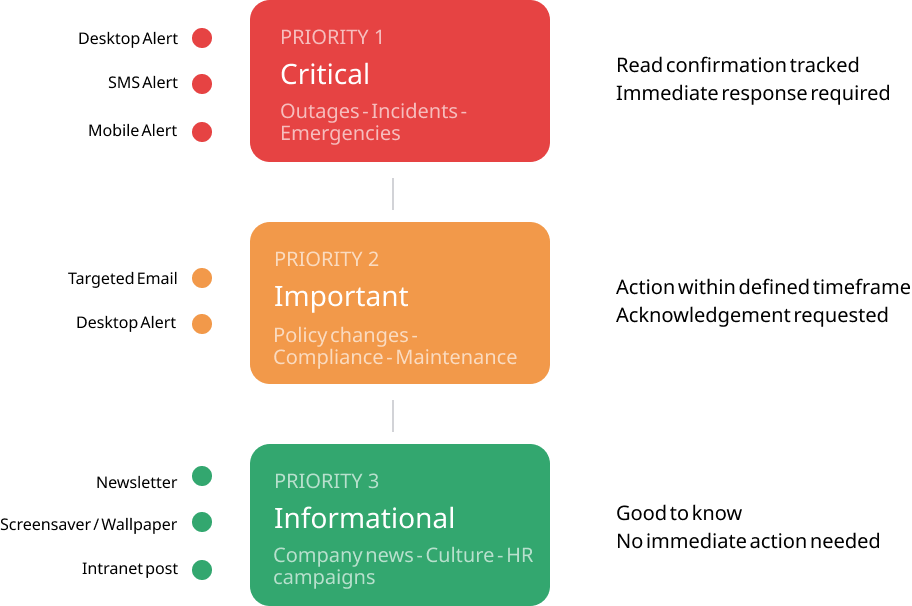
Not every message deserves the same weight. Defining a rough hierarchy helps both senders and receivers:
Having this hierarchy agreed and documented prevents escalation creep - the tendency for Priority 3 information to start arriving via Priority 1 channels, which trains employees to ignore alerts.
Three-tier hierarchy matching urgency to channel - preventing "priority creep" that erodes employee trust in alerts.
An employee engagement programme is only as good as its execution. This stage is about building the operational infrastructure that makes consistent delivery possible - particularly when there are multiple teams, departments, or locations involved.
Build an editorial calendar
An editorial calendar is the backbone of a well-run communication programme. It maps out all planned communications across a 12-month period (company-wide campaigns, recurring newsletters, compliance comms cycles, seasonal HR activities, product launches and any major change programmes) giving the team visibility of what's coming and the ability to spot conflicts or gaps.
It doesn't need to be sophisticated. A shared spreadsheet or project management tool with date, topic, channel, owner and status columns is sufficient for most teams.
The Gallagher State of the Sector report consistently highlights communication consistency as a top employee expectation. Employees cite predictable, reliable cadence as more important than volume or frequency. An editorial calendar is how you deliver that consistency.
Define ownership and governance
Who can send what, to whom, through which channels and with what approval process? Without clear governance, organisations end up with too many voices on too many channels, eroding clarity and trust. Define:
Establish manager enablement
Managers are the most influential communicators in any organisation. Gallup's research consistently finds that the manager relationship is one of the strongest drivers of employee engagement. Yet many managers are left to communicate without briefings, toolkits or talking points and inconsistent cascade of messages is the result.
Building a simple manager communication toolkit including message summaries, suggested talking points and FAQs for anticipated questions, dramatically improves the quality of team-level communication.
Plan for crisis and urgency
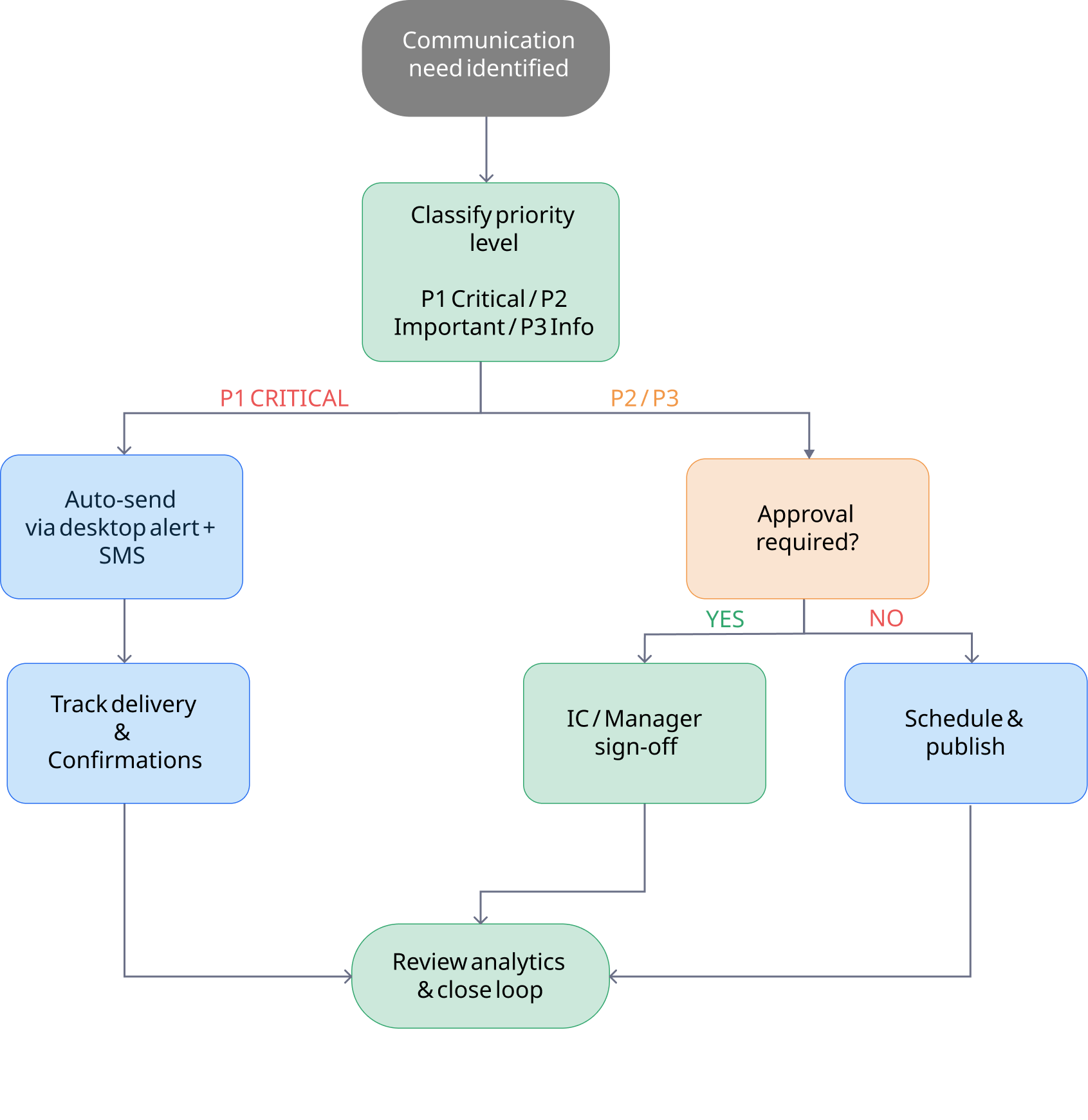
Every communication programme needs a documented protocol for urgent and crisis scenarios, established well before they're needed. This should cover: who triggers an alert, which channels are used in sequence, what confirmation mechanisms are in place and who is responsible for follow-up communications.
Pre-built message templates for common high-urgency scenarios (IT outages, safety incidents, severe weather, security threats) let teams act in seconds rather than minutes when it matters most.
Decision path from identifying a communication need through to delivery and tracking.
A communication programme without measurement is effectively a broadcast function. Measurement is what transforms it into a feedback-driven system that improves over time.
What to measure
The metrics you track should connect directly to the objectives you set in Stage 2. Common categories include:
ICPlan's measurement guide recommends going beyond open rates to track behavioural outcomes: the changes in action that prove communication is landing, not just arriving.
A/B testing your messages
You don't need a large data science team to test your communications. Even simple experiments, such as sending the same message with two different subject lines to random halves of your audience or comparing desktop alert vs email delivery for the same content, generate useful data over time. The goal is to build an evidence base for what works with your specific workforce.
Two-way communication and feedback loops
One of the most significant gaps in most organisations' communication programmes is the absence of genuine two-way dialogue. The Gallagher State of the Sector report identifies employee listening as one of the most underdeveloped areas of internal communication practice. Most internal communication departments have limited mechanisms for feedback beyond annual engagement surveys, which arrive too infrequently to be actionable.
Shorter, more frequent pulse surveys tied to specific communications or campaigns, open comment channels on intranet posts and regular "listening sessions" with representative employee groups all contribute to a healthier feedback culture.
Critically, feedback only builds trust when it visibly influences action. Closing the loop, letting employees know what you heard and what changed as a result, is what differentiates a genuine two-way programme from one that just collects data.
-> How to Build a Voice of the Employee Programme from Scratch
Quarterly review cadence
Build a structured review rhythm into the programme from the start. A quarterly review should cover: how key metrics moved against objectives, what the editorial calendar looks like for the next quarter, any changes to channel strategy or governance and feedback themes from employees and managers. An annual review should revisit the strategic alignment of the programme and reset objectives for the year ahead.
Even well-intentioned communication programmes fall into predictable traps. These are the most common:
Over-reliance on email. Email remains the most-used channel in most organisations but it is increasingly ineffective as a primary vehicle for important communications. It works reasonably well for non-urgent updates and newsletters but urgent messages get buried. Urgent messages need dedicated channels with appropriate urgency signals.
No single owner. When everyone is responsible for internal communication, no one is. The most effective programmes have a named owner with authority and accountability, even if the day-to-day work is distributed across teams.
Communicating at employees rather than with them. The one-way broadcast model builds passive recipients, not an engaged workforce. Research by Gartner found that only 29% of employees are satisfied with collaboration at work. Two-way communication (feedback channels, manager conversations, surveys with visible action) is what builds genuine engagement.
Treating all employees the same. Deskless, frontline, and remote workers are chronically under-served by communication programmes designed around desk-based staff. If a significant proportion of your workforce doesn't sit at a computer, your channel strategy needs to reflect that.
Measuring outputs instead of outcomes. Sending 200 messages a month is an output. Improving employee understanding of safety procedures is an outcome. The former is easy to track; the latter is what matters.
Starting with channels before goals. Many organisations acquire tools and channels first, then try to work out what to do with them. Effective programmes start with goals and audience needs, then select channels to serve those needs.
.svg)
FAQ
We hope this section will help you better understand Heed's internal communication platform




Talk to us about keeping your employees informed, engaged and inspired - book a call today!
Book a Call
Proudly connecting teams worldwide, enhancing communication, and boosting employee engagement for a unified workforce.
.svg)
.svg)
© Heed 2026 - All Rights Reserved