What is a daily safety message?
A daily safety message is a short, focused communication delivered to staff at the start of a shift or working day to keep a specific safety topic front of mind. Unlike a toolbox talk, which is task-specific and delivered before a particular job, or a safety moment, which is typically spoken aloud at a meeting, a daily safety message is a written prompt that can be delivered through multiple channels simultaneously: a desktop alert, a screensaver, a ticker or a lock screen. Its strength is consistency: a message delivered every day, without exception, builds the habit that a quarterly safety briefing cannot.
50 daily safety message ideas
The messages below are grouped by theme. Each is written to work as a standalone prompt that can be sent as written, read aloud at a stand-up, or adapted for your site and current conditions.
Slips, trips and falls
- Clear one trip hazard in your area before you start today. It takes thirty seconds and could prevent a serious injury.
- Wet floor? Report it, sign it and stay off it until it is dry. Do not assume someone else has already done it.
- Trailing cables are a trip hazard and a fire risk. Take a moment to route and secure any cables in your area today.
- Good housekeeping is not optional. A clear walkway is a safe walkway. Take responsibility for your immediate environment.
- Check your footwear before starting. The right footwear for the task is a control, not a dress code.
Manual handling
- Before you lift: assess the load, plan the route, clear the path and ask for help if in doubt. Your back will thank you.
- If a load needs two people to carry it safely, it needs two people. There is no such thing as managing it alone.
- Mechanical handling aids are there to be used. Using a trolley is not admitting weakness; it is avoiding an injury.
- Awkward loads cause more injuries than heavy ones. Take time to get a good grip and keep the load close to your body.
PPE and equipment
- Check your PPE before you put it on. Damaged or ill-fitting protection is not protection. Report and replace it.
- PPE is the last line of defence, not the first. Make sure the other controls are in place before you rely on it.
- If you would not use a damaged tool, do not use damaged PPE. Tag it, remove it and request a replacement.
- Your PPE fits only you. Do not share it, borrow it or adapt it. Report shortages to your supervisor.
Hazardous substances
- Know what you are working with today. If you are using a chemical, know where its safety data sheet is and what to do if something goes wrong.
- Store chemicals correctly, label them clearly and never decant into unmarked containers. An unlabelled substance is an unknown risk.
- Skin contact with many common substances causes lasting damage. Wear the correct gloves for the task, not whatever is closest to hand.
- Ventilation is a control, not a comfort. If the area feels fine without it, open it anyway.
Fire safety
- Know your nearest fire exit and the route to the assembly point from exactly where you are standing right now.
- Fire exits are not storage areas. If you see a blocked exit, clear it or report it immediately.
- If the alarm sounds, leave. Do not collect belongings, do not use the lift, do not go back for anything.
- Know which extinguisher to use on which type of fire. Using the wrong one can make a fire worse.
Emergency preparedness
- Do you know who the first aider is on your shift today? If not, find out before you need to.
- The defibrillator is located [location]. In a cardiac event, the first few minutes are everything.
- Emergencies are not predictable. Your response has to be. Review the emergency procedure for your area today.
- If something does not look right, say something. Near misses reported today are incidents prevented tomorrow.
Mental health and wellbeing
- Tiredness impairs judgement as much as alcohol. If you are too tired to work safely, say so. It is always the right call.
- Stress affects safety. If your workload is unmanageable, talk to your supervisor. Carrying on regardless is not resilience.
- Take your breaks. They are a safety measure, not a reward. Sustained concentration without rest increases error rates.
- Look out for your colleagues today. A distracted or quiet team member may need a check-in, not just a task.
Behaviour and culture
- The standard you walk past is the standard you accept. If you see an unsafe act or condition today, address it.
- Complacency causes incidents on familiar tasks. Treat today's routine as if it were your first time doing it.
- Speaking up about a safety concern is never the wrong thing to do. It is always backed here.
- Near misses are free lessons. Log them, share them and act on them before they become something worse.
- New starters do not yet know what you know. If you see someone unsure today, take a moment to show them.
Driving and vehicle safety
- Before you drive for work today: is the vehicle checked, your route planned and your phone on do not disturb?
- Fatigue is a factor in a significant proportion of road incidents. If you are too tired to drive safely, do not.
- Pedestrians and vehicles do not mix. Stay in marked pedestrian routes on site and never cut through vehicle zones.
- A moment's distraction at speed can be irreversible. Eyes on the road, phone away, every journey.
Lone working
- Working alone today? Make sure someone knows where you are, what you are doing and when to expect you back.
- Check in as agreed. A missed check-in triggers a response. That is the whole point of the system.
- If something feels unsafe when you are alone, stop the task. There is no job worth doing without appropriate backup.
- Lone workers are at greater risk because help takes longer to arrive. Take fewer risks, not more.
Seasonal and environmental
- Hot weather increases the risk of heat stress, dehydration and distraction. Drink water regularly and take shade breaks today.
- Cold conditions reduce dexterity and concentration. Dress appropriately, warm up properly and watch for ice underfoot.
- Wet weather changes the risk profile of almost every outdoor task. Reassess your site conditions before starting today.
- Reduced daylight means reduced visibility. Check your lighting, your high-visibility clothing and your routes before starting.
How to make daily safety messages work
A safety message is only as good as its reach. A few principles keep them from becoming wallpaper:
- Vary the topic: repeating the same message desensitises people to it. Rotate through the categories above so the message always feels relevant.
- Tie it to the day: a message about heat stress lands better on a forecast hot day. A message about ice lands better in January. Relevance drives attention.
- Keep it short: one point, one action. A message that asks people to do three things will result in them doing none.
- Match the channel to the audience: a desk-based message on a screensaver reaches office staff; a desktop alert reaches everyone logged in; a lock screen message is seen at every login regardless of role.
- Track acknowledgement: for messages that must be evidenced, acknowledgement tracking gives a timestamped record of who saw each one. That record matters at audit time.
Getting daily safety messages to every shift
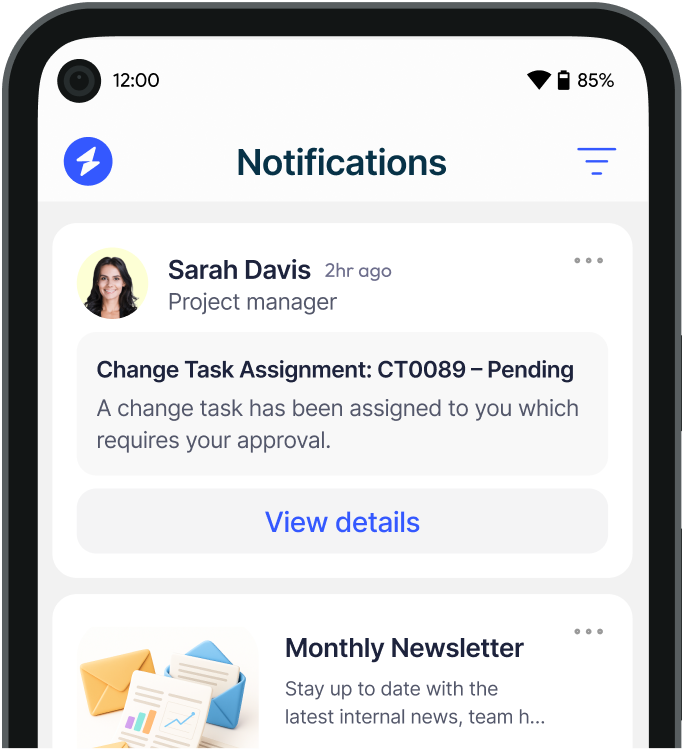
The challenge with daily safety messages is not writing them; it is making sure they reach every person, on every shift, at every site, without relying on a manager to manually forward an email. Desktop alerts push messages to every logged-in device simultaneously. Lock screens ensure the message is seen at every login, regardless of when the shift starts. Screensavers and tickers keep safety visible throughout the day without interrupting work. And where acknowledgement is needed, tracking confirms who has seen each message and when. See how this works for organisations with distributed and shift-based teams on our health and safety solution page, and browse the full set of workplace safety topics to build out your programme.





.svg)
.svg)
.svg)