

Most organisations still measure how employees feel once a year. A survey goes out, response rates limp along, and by the time the results are analysed, half the findings are already out of date. Meanwhile the moments that actually shape sentiment, a reorganisation, a rocky product launch, a change in leadership, happen in the gaps between surveys and go completely unmeasured.
That gap is becoming harder to justify. Internal comms teams are under more pressure than ever to show that communication drives measurable outcomes, not just to report an engagement score once a year and hope it trends upward. This piece looks at what's replacing, or supplementing, the annual survey in 2026: pulse surveys, eNPS, behavioural signals, and AI-assisted sentiment analysis, and how to build a measurement approach that catches problems while they're still fixable.
At a Glance
- A majority of internal communicators report low confidence in measuring employee sentiment accurately using annual surveys alone.
- Teams with high confidence in their analytics are far more likely to run pulse surveys and track eNPS than teams relying solely on annual engagement surveys.
- Sentiment analysis is one of the fastest-growing uses of AI in internal comms, alongside content drafting and meeting summarisation.
- Opens, click-through, time spent reading and drop-off points reveal disengagement before an employee ever fills in a survey.
- Most executives want internal comms impact reported in business terms such as productivity and retention, which needs continuous data rather than a single annual snapshot.
Table of Contents
Why the annual survey is losing ground
The annual engagement survey has been the default measurement tool in internal comms for decades, and it still has a place. It's structured, it's comparable year on year, and it covers ground a two-question pulse never will. The problem isn't the survey itself. It's the assumption that one data point a year is enough to understand something that changes constantly.
Three things are wearing down confidence in the annual-only approach. Response rates are falling as employees face more surveys from more parts of the business, and fatigue shows up as shorter, less thoughtful answers. The data goes stale fast: a survey run in January says nothing about how people felt after a September restructure. And leadership is asking harder questions than "what's our engagement score", they want to know how communication affects retention, productivity and compliance, which a once-a-year snapshot simply can't support.
Some teams have already moved toward more frequent, lighter-touch listening. Our piece on smart well-being surveys covers a good starting point for shorter, more frequent check-ins, but a single survey format still only tells part of the story. The shift underway in 2026 is toward combining several measurement types rather than picking one.
What gets missed between surveys
Think about what actually happens in a typical year: a reorganisation, a leadership change, a product launch that goes sideways, a merger rumour that spreads before anyone confirms it. Each of these moves sentiment sharply, and an annual survey captures none of it unless the timing happens to align.
Frontline and deskless employees are particularly likely to fall through the gap. If your primary listening channel is an email survey, you're already missing a large share of the workforce that doesn't sit at a desk checking their inbox. Sentiment problems in that population often show up as quiet disengagement long before anyone raises a concern in a formal channel.
That quiet disengagement is the pattern worth watching for. Employees rarely announce that they've checked out. They stop opening messages, stop attending optional sessions, stop responding to asks. By the time it surfaces in survey data, it's often already affected retention. Programmes built around continuous listening, like the approach outlined in how to build a voice of the employee programme, are designed specifically to catch this earlier.
The real-time measurement toolkit
Pulse surveys
Short, focused surveys sent monthly or quarterly. Two to five questions, low friction, designed to be answered in under a minute. The value isn't in any single response, it's in the trend line: is sentiment on a particular topic improving or declining over the last three cycles.
eNPS
Employee Net Promoter Score asks one question: how likely are you to recommend this organisation as a place to work. It's blunt, but that's the point, it's fast enough to run often and simple enough to benchmark against previous quarters without any analysis overhead.
Behavioural and engagement signals
This is the passive layer: opens, clicks, time spent reading, repeat views, and where people stop engaging. It doesn't ask employees anything, it just watches what they actually do. This is also where acknowledgement tracking earns its keep, since seeing whether a message was actually read and confirmed gives a much sharper read on genuine engagement. We cover this in more detail in audit-ready communication.
AI-assisted sentiment analysis
Free-text survey responses and open comment fields contain a lot of nuance that multiple-choice questions miss, but reading them all manually doesn't scale past a few hundred employees. In regulated sectors, it matters how and where that analysis happens, and whether the data stays within your own infrastructure.
Combining methods: what a modern sentiment stack looks like
None of these methods replace each other. They sit at different points on a spectrum from deep-and-infrequent to shallow-and-continuous, and a mature measurement approach uses all four together rather than picking a favourite.
The annual survey still earns its place as the deep benchmark, the one moment a year with enough structure to cover topics a two-question pulse never could. Pulse surveys and eNPS sit above it, tracking trend lines month to month or quarter to quarter. Behavioural signals run continuously in the background with no extra effort from employees at all. And AI sentiment analysis adds depth to the free-text layer that would otherwise go unread.
The point isn't to run all four constantly. It's to know which layer to lean on for which question. Want a comprehensive yearly benchmark against previous years? Annual survey. Want to know if sentiment shifted after last month's announcement? Pulse or eNPS. Want to catch disengagement before anyone says anything? Behavioural signals. Want to understand what people actually mean in their free-text comments, at scale? AI sentiment analysis.
Turning sentiment data into action
None of this matters if the data sits in a dashboard nobody acts on. The single biggest reason sentiment measurement programmes lose credibility is that employees give feedback, see nothing change, and stop bothering to respond honestly the next time round.
Closing the loop doesn't need to be elaborate. It means telling employees, in plain terms, what was raised and what's being done about it, even if the answer is "we heard this and we're still working on it." Silence reads as indifference, even when work is happening behind the scenes.
Routing matters too. Sentiment findings need to land with the right owner, whether that's HR, a specific department lead, or a line manager, rather than sitting in a report that only the comms team sees. And where possible, tie the trend data to business metrics that leadership already cares about: retention, absence rates, compliance completion.
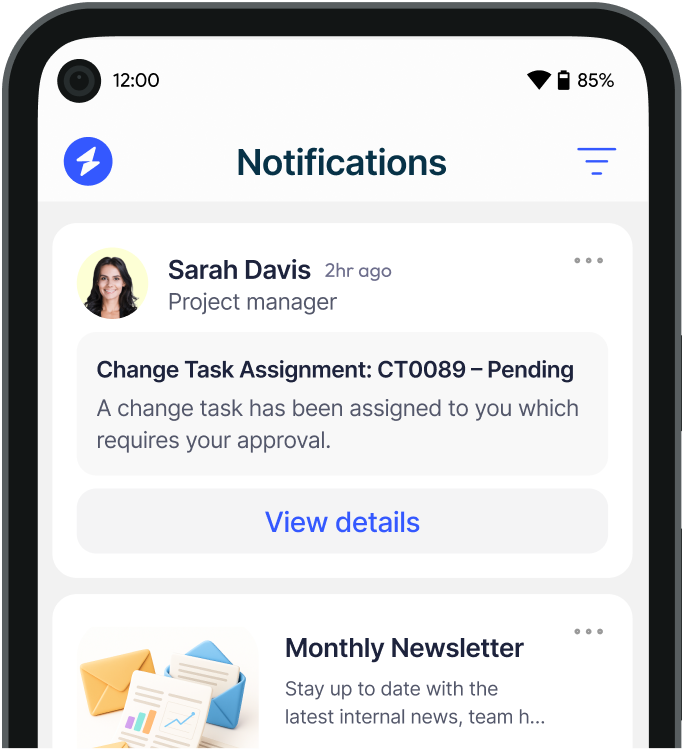
Heed's employee survey tools support this kind of continuous listening loop, from pulse-style surveys through to the acknowledgement data that shows whether a follow-up message actually landed. For a broader view of how this fits into an internal communications strategy, see our internal communications solutions page.
A practical rollout plan
If none of this exists yet, don't try to stand up all four layers at once. A staged rollout works better:
- Audit what you're already doing. Most organisations have more sentiment data than they realise, scattered across HR systems, comms platforms and ad hoc surveys.
- Pick one pulse cadence and stick to it. Monthly or quarterly, a small set of consistent questions, sent to a representative group first.
- Add one passive signal. Message opens and acknowledgement rates are usually the easiest place to start.
- Pilot with a single department or site. Prove the approach works and that the loop actually closes before rolling out organisation-wide.
- Report back to employees. Show, publicly, what changed because of the first round of feedback.
- Expand gradually. Add eNPS, then AI-assisted analysis of free-text responses, once the earlier layers are running reliably.
.svg)


.svg)






.avif)


.svg)
.svg)