A fire evacuation procedure is a documented plan that tells everyone in a building what to do, where to go and who is responsible when a fire alarm sounds. A good procedure covers the full sequence: raising the alarm, evacuating safely, accounting for everyone at the assembly point and liaising with the emergency services. It applies whether the alarm is a drill or the real thing, and it should be followed identically in both cases so that the muscle memory is there when it matters.
In the UK, the Regulatory Reform (Fire Safety) Order 2005 requires employers and building owners to put in place and maintain a fire evacuation procedure as part of their fire risk assessment. In the US, OSHA's Emergency Action Plan standard (29 CFR 1910.38) sets equivalent requirements for most workplaces. In both cases, the duty is not just to have a procedure on paper but to make sure every person in the building knows it.
Every procedure will differ by building and occupancy, but the following elements should be covered in any workplace evacuation plan.
The procedure should make clear how to raise the alarm: the location of manual call points, the sound of the alarm and the expectation that anyone discovering a fire raises the alarm immediately before doing anything else. Staff should also know how to alert colleagues who may not hear the alarm, including those wearing hearing protection or working in noisy environments.
Every person in the building should know at least two evacuation routes from their usual location, in case the primary route is blocked. Routes should be clearly signed, kept free of obstructions at all times and checked as part of regular inspections. Designate a primary and secondary route for each floor or zone and make sure these are covered in inductions for new starters and visitors.
The assembly point must be far enough from the building that evacuees are clear of any emergency response, but clearly enough defined that everyone goes to the same place. Large sites may need multiple assembly points by zone. Make the location obvious, sign it clearly and confirm it in every drill and induction.
A procedure without named roles is a procedure that breaks down under pressure. At minimum, every workplace needs:
Any person who may need assistance to evacuate, whether due to mobility, sensory impairment or temporary injury, should have a personal emergency evacuation plan (PEEP) agreed in advance. Refuge areas should be identified, and fire wardens should know which individuals are in their zone and what assistance is needed.
The procedure must include a clear method for confirming that everyone has evacuated. Roll calls work for small teams; visitor sign-in systems and contractor logs matter for larger sites. The marshal at the assembly point should be able to report to the fire service whether all persons are accounted for.
When the fire service arrives, someone must be ready to meet them, confirm the nature of the incident, provide the building layout and advise on any persons unaccounted for or known to be in the building. This role should be named in the procedure.
Having a procedure is the starting point. Getting it into every person's head before an incident is the harder part, and it is where most organisations fall short.
Every new employee, contractor and regular visitor should receive a briefing on the evacuation procedure before they start work in the building. For contractors and agency workers who rotate frequently, this means a repeatable, documented induction rather than a verbal walk-through that leaves no record.
Evacuation routes, exit locations and assembly points should be clearly signed throughout the building. Floor plans showing evacuation routes are a legal requirement in many jurisdictions and a practical aid everywhere. Screensavers and desktop wallpaper can reinforce the assembly point location and warden contact details as a constant, low-friction reminder.
The HSE recommends fire drills at least once a year; higher-risk premises and those with high staff turnover benefit from more frequent practice. Drills should be treated as real evacuations and debriefed afterwards: how long did it take, were all zones accounted for, were any routes obstructed? The debrief is where the procedure improves.
A procedure that was accurate when it was written may not reflect the building today. Any change to the layout, occupancy, fire warden roles or alarm system should trigger a review. At minimum, review the procedure annually and after any significant incident or near miss.
For organisations with multiple sites, shift workers or a high proportion of deskless staff, getting an updated evacuation procedure in front of everyone is a genuine operational challenge. An email goes unread; a poster in the break room misses the night shift; a verbal briefing at handover is undocumented.
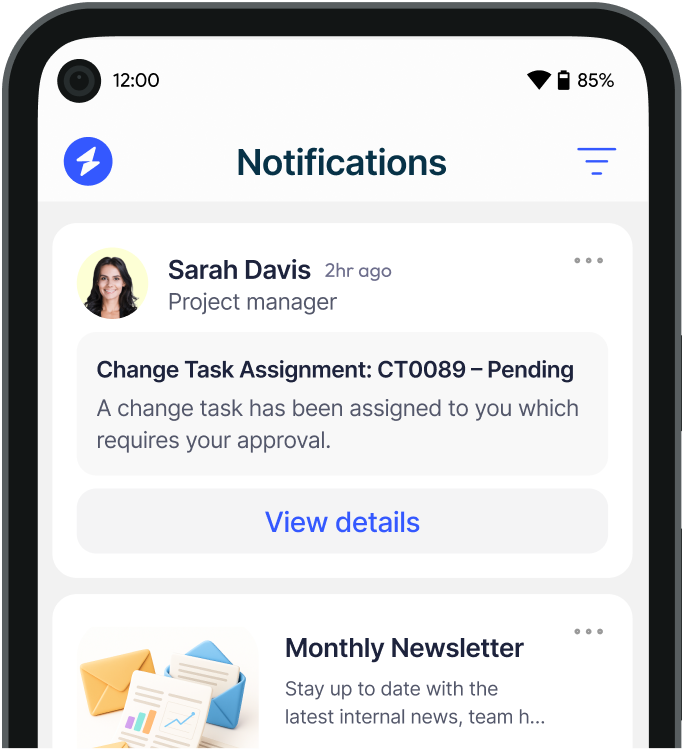
The most reliable approach combines channels: a desktop alert for any urgent change to the procedure that must be seen immediately, a lock screen message to reinforce assembly point details at every login, and acknowledgement tracking so there is a timestamped record of who has confirmed they have read the updated procedure. That audit trail is exactly what is needed if a regulator or insurer asks for evidence of communication after an incident. See how this works for safety-critical teams on our health and safety solution page, and explore more workplace safety topics for your communications programme.
See how Heed streamlines internal communication across desktop, mobile, and shared screens - so every message gets noticed.
We’ll walk you through creating, targeting, and tracking notifications in real time, tailored to your organisation’s goals.
Schedule a Demo
See how Heed works across your channels, sites and shifts, and get answers to the questions specific to your industry and team size.
Schedule a Demo




Talk to us about keeping your employees informed, engaged and inspired - book a call today!
Book a Call
Proudly connecting teams worldwide, enhancing communication, and boosting employee engagement for a unified workforce.
.svg)
.svg)
© Heed 2026 - All Rights Reserved
.svg)