What is a toolbox talk?
A toolbox talk is a short, task-specific safety briefing delivered on site before work begins. Unlike a safety moment, which raises general awareness, a toolbox talk focuses on the exact hazards and controls for the job about to be carried out. It is typically five to fifteen minutes, led by a supervisor, and aimed at the crew doing the work rather than the whole organisation. The name comes from the informal setting: historically delivered around the toolbox, on the floor, before the shift starts.
Toolbox talks are a recognised best-practice method under both OSHA and HSE guidance, and they provide a documented record that workers were briefed on specific risks before a task. That record matters at audit time and, more critically, in the event of an incident investigation.
Toolbox talk topics by industry
The most effective toolbox talk is the one that matches the work being done that day. The lists below cover the topics most relevant by sector, with a short note on each. Use them as written or adapt them to your site, task and recent near misses.
Construction and civil engineering
- Working at height: Before any elevated work, confirm the equipment is inspected, the exclusion zone is set, and every worker on the task knows the fall-arrest plan.
- Excavation and ground works: Cover the permit-to-dig process, buried services, shoring requirements and the signs of ground instability before anyone enters a trench.
- Lifting operations: Walk through the lift plan, confirm the slinger/signaller roles, check the equipment certification and establish the exclusion zone beneath the load.
- Hot works: Before any welding, cutting or grinding, confirm the permit is in place, flammable materials are cleared, a fire watch is assigned and extinguishers are to hand.
- Confined space entry: Cover the permit, atmospheric testing, rescue arrangements and the buddy system before any entry. This one should never be skipped.
- Hand-arm vibration (HAV): When vibrating tools are in use, remind crews of the daily exposure limits and the importance of rotation to prevent long-term injury.
- Concrete and cement: Skin burns from wet cement are common and underreported. Cover correct PPE, washing facilities and the risk of prolonged contact.
- Plant and pedestrian separation: On mixed sites, reinforce the exclusion zones, banksman signals and the rule that plant operators never move without confirming the zone is clear.
- Manual handling on site: Remind crews of the specific loads they will handle that day and the team-lift or mechanical-aid approach for anything over the safe single-person limit.
Manufacturing and warehousing
- Lockout/tagout (LOTO): Before any maintenance or cleaning of machinery, confirm the isolation procedure, the tag is in place and no one else can re-energise the equipment.
- Forklift and pedestrian safety: Reinforce the traffic routes, designated pedestrian walkways and the rule that forklifts have absolute right of way in marked zones.
- Chemical handling and spill response: Walk through the safety data sheet for any hazardous substance being used that day, the correct PPE and the first steps if a spill occurs.
- Conveyor and machinery guarding: Remind operators that guards are non-negotiable during production and that a missing guard is a stop-work situation, not a workaround.
- Ergonomics and repetitive strain: For lines with repetitive tasks, cover correct posture, rotation schedules and how to flag early signs of discomfort before they become an injury.
- Pallet racking inspection: Damage to racking is often unreported until a collapse. Walk crews through what to look for and the immediate action if damage is found.
- Noise exposure: For high-noise areas, confirm hearing protection is worn throughout, not just when noise is at its loudest, and that exposure limits are being managed through rotation.
- Slip prevention in wet areas: In food production or washdown environments, reinforce correct footwear, clean-as-you-go and the importance of reporting wet floors immediately.
Healthcare and social care
- Manual handling of patients: Cover the assessment, the equipment available and the team approach before any moving and handling task involving a patient or resident.
- Needle stick and sharps injuries: Reinforce safe disposal, the immediate reporting protocol and the steps to take in the first minutes after an injury.
- Infection prevention and control: Before any task with infection risk, confirm PPE selection, hand hygiene protocol and the donning and doffing sequence.
- Lone working in the community: For community-based staff, walk through the check-in procedure, what constitutes a trigger to escalate and how to raise the alarm discreetly.
- Aggression and conflict: Cover de-escalation techniques, when to disengage and the reporting requirement after any incident, however minor it seemed.
- Medication safety: Reinforce the five rights (right patient, drug, dose, route, time) and the duty to report near misses without blame.
Facilities management and maintenance
- Asbestos awareness: For anyone working in older buildings, cover how to identify potential asbestos-containing materials, the stop-work rule and who to call before disturbing anything.
- Working alone: Confirm the check-in schedule, what information the lone worker has shared with a colleague and the escalation path if they do not check in.
- Electrical isolation: Before any electrical work, confirm the circuit is isolated, tested and locked off, and that no one else can restore power during the task.
- Roof access: Cover the permit, the edge-protection arrangements, anchor points and the weather check before any roof access task.
- Legionella awareness: For anyone working on water systems, cover the risk, the temperature control requirements and the sampling and recording obligations.
- Contractor management: Before a contractor arrives on site, confirm the induction, the permit to work, the emergency contact and the expected sign-in and sign-out process.
How to run a toolbox talk that people actually listen to
A toolbox talk only works if the people in the room are paying attention. A few principles keep them from becoming a box-ticking exercise:
- Keep it to the task at hand: cover one job, one set of hazards. A talk that tries to cover everything covers nothing.
- Use the site as the backdrop: wherever possible, deliver the talk at the work location so people can see the actual hazards being discussed.
- Make it a conversation: ask what the crew has seen go wrong before on similar tasks. Experience in the room is more persuasive than a printed sheet.
- Record it: a brief sign-in sheet or digital acknowledgement gives you the evidence that the briefing happened and who attended.
- Follow up on actions: if a hazard is raised during the talk, act on it visibly. Nothing undermines a safety culture faster than concerns that disappear.
Making sure toolbox talks reach every shift
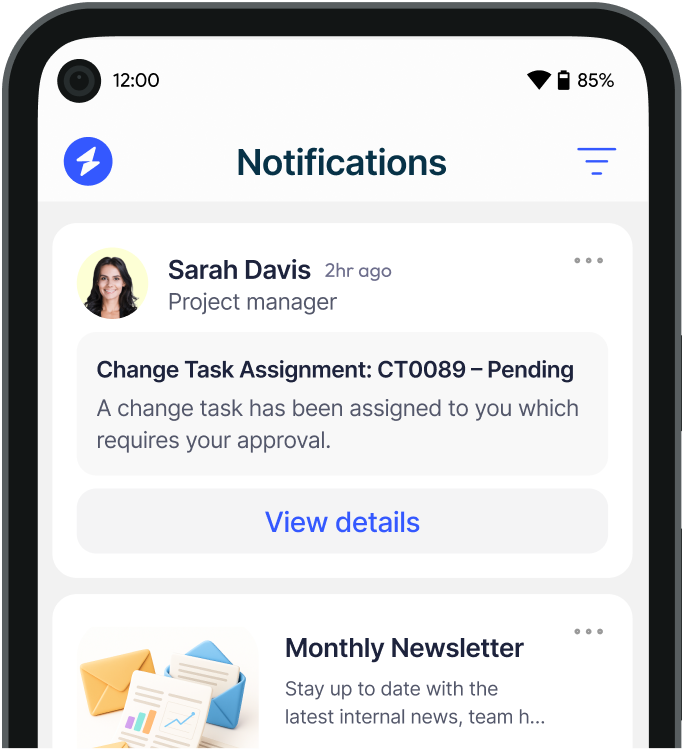
Toolbox talks work well for teams assembled in one place. They are harder to deliver consistently across multiple sites, rotating shifts or remote crews. For organisations running safety communications across distributed teams, the same message needs to reach the people who were not in the room: through desktop alerts for urgent updates, lock screens for daily reminders and acknowledgement tracking to confirm who has seen each briefing. See how this works across distributed teams on our health and safety solution page, and explore the full range of workplace safety topics for more ideas.





.svg)
.svg)
.svg)