Before examining specific examples, it is worth establishing the criteria against which crisis communication can be assessed. Effective crisis communication tends to share four characteristics: it is fast (issued before the vacuum fills with speculation), accurate (built on confirmed facts rather than assumptions), consistent (the same core message across all channels and audiences), and audience-appropriate (the right level of detail for each recipient group).
Ineffective crisis communication tends to fail on one or more of the same dimensions: too slow, too vague, contradicted by other sources, or pitched at the wrong audience. The failure modes are consistent across industries and incident types, which is why the lessons from one sector apply readily to another.
During a major IT outage at a financial services firm, the IT and communications teams activated a desktop alert to all staff within four minutes of the incident being declared. The message was brief: the specific systems affected, the estimated restoration window, the workaround for time-critical processes, and the name of the person to contact. Because the alert required acknowledgement before it could be dismissed, the communications team had confirmation within 15 minutes that 94% of connected staff had received the message.
What made this effective: the speed of notification prevented speculation about what had happened; the specificity of the content gave staff something actionable; and the acknowledgement data allowed the response team to identify sites with low receipt rates and follow up directly. The decision to use a desktop alert rather than email was deliberate — the affected systems included parts of the email infrastructure, making desktop alerts the only channel with full reach.
A construction company with multiple sites activated its emergency notification system following a gas leak at one facility. Within two minutes, a desktop alert was pushed to all devices at the affected site directing staff to the assembly point. A secondary alert was pushed to all other sites confirming that they were not affected. The lock screen at the affected site was updated to display the assembly point location and the name of the site emergency coordinator.
The separation of audiences — affected site versus unaffected sites — is the lesson here. A blanket all-staff alert would have caused unnecessary alarm and action at sites with no involvement in the incident. Targeted messaging, enabled by Active Directory group segmentation, delivered the right message to the right people without confusion.
A healthcare organisation experienced a ransomware attack on a Tuesday morning. The IT team was aware of the incident by 08:30. The first staff-wide communication was sent at 14:15 — nearly six hours later. By that point, staff had been sharing information informally for most of the morning: the version of events circulating internally was significantly more alarming than the actual situation, and several staff members had shared their version on personal social media.
The lesson is straightforward: the longer the communication gap, the harder the recovery. A brief, accurate holding message at 09:00 — even one that acknowledged only that there was an IT issue under investigation — would have given staff an authoritative source and reduced the spread of speculation. The delay was driven by a desire to have full information before communicating; the effect was the opposite of the intention.
A manufacturing company issued a single communication to all staff following a serious injury at one of its sites. The message included operational information relevant only to the site supervisor group, emotional support language aimed at colleagues of the injured person, and compliance instructions relevant only to the safety team. The result was a message that confused most of its recipients, gave some of them information they were not meant to have, and failed to give others the specific instruction they needed.
The lesson: segment your audiences. What the safety team needs is not what the wider workforce needs. A single message trying to serve multiple audiences usually serves none of them well.
Financial services organisations face a specific communication challenge: they often cannot say as much as they would like during a crisis, due to regulatory constraints or legal advice. The organisations that handle this best have pre-agreed frameworks for what can be said at each stage and have trained their spokespeople to communicate clearly within those constraints. "We are unable to comment on the specifics, but we can confirm that customer data has not been affected" is more reassuring than silence and more defensible than speculation.
Healthcare crisis communication involves multiple audiences with significantly different needs: clinical staff need operational instructions; patients and visitors need safety information; regulators need evidenced notifications. Organisations that manage this well treat each audience as a separate communication workstream with its own message, channel and timing, rather than attempting to construct a single message that covers all three.
Major IT outages are among the most common crisis scenarios for organisations of all types. The communication standard that has emerged in this sector — established partly by the public-facing incident pages of cloud providers — is the timestamped status update: a regular, brief, factual update at defined intervals, maintaining a consistent format from initial incident to resolution. Applied internally, this approach gives staff and leadership a reliable information source and reduces the volume of status queries directed at the response team.
The recurring theme across all these examples is preparation. The organisations that communicate well in a crisis are almost never doing so by instinct. They have pre-approved templates, tested channels, segmented audience lists and designated communicators. The examples above illustrate what that preparation enables; the crisis communication plan guide sets out how to build it.
See how Heed streamlines internal communication across desktop, mobile, and shared screens - so every message gets noticed.
We’ll walk you through creating, targeting, and tracking notifications in real time, tailored to your organisation’s goals.
Schedule a Demo
See how Heed works across your channels, sites and shifts, and get answers to the questions specific to your industry and team size.
Schedule a Demo




Talk to us about keeping your employees informed, engaged and inspired - book a call today!
Book a Call
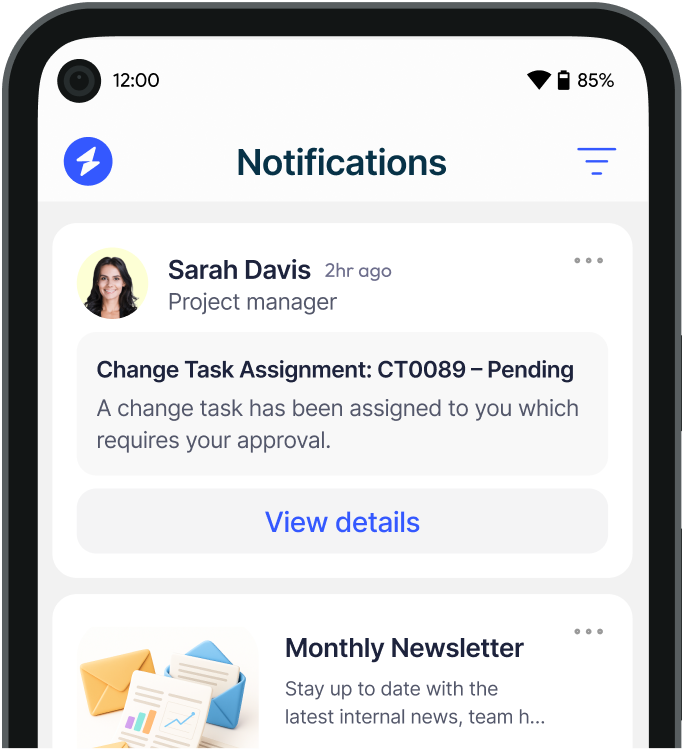
Proudly connecting teams worldwide, enhancing communication, and boosting employee engagement for a unified workforce.
.svg)
.svg)
© Heed 2026 - All Rights Reserved


.svg)