
A crisis communication strategy is the set of principles and decisions that guide how an organisation communicates when things go wrong. It sits above the crisis communication plan: while the plan documents the who, what and how, the strategy defines the underlying approach — the values and priorities that should inform every message, every channel choice and every timing decision during a crisis.
Organisations that communicate well in a crisis do not improvise their values under pressure. They have established them in advance: they know whether they will prioritise transparency or control, speed or accuracy, internal audiences or external ones. The strategy is what makes those decisions consistent across the crisis team and across the duration of the incident.
The most damaging thing an organisation can do in the early stages of a crisis is say nothing. Silence is not neutral; it creates a vacuum that others will fill. A holding statement issued within the first hour — even one that says only what is known, what is being investigated and when the next update will arrive — is almost always better than a polished statement issued three hours later. The standard for initial crisis communication is not accuracy plus completeness; it is accuracy plus speed, with completeness to follow.
Different audiences need different levels of detail, but the core facts must be consistent. An internal message that contradicts the external statement does not reassure employees; it creates a second crisis: a trust crisis. Every message across every channel should reflect the same underlying facts, even where the framing and depth differ.
Transparency is not the same as disclosure of everything. A crisis communication strategy should define the organisation’s approach to transparency: what will be shared, what will not, and on what grounds. In regulated industries this will be partly determined by legal and compliance requirements. The principle is that what is withheld should be withheld for a defined and defensible reason, not because disclosure is uncomfortable.
Employees almost always come first. They are the people whose safety may be at risk, whose behaviour the organisation needs to direct, and whose trust is the hardest to rebuild once lost. Communicating with staff before communicating with media is not just an ethical preference; it is strategically sound. An employee who hears about a crisis on the news before hearing from their employer is not a neutral party in what follows.
Designating a named spokesperson — and at least one deputy — before a crisis removes a significant source of delay and inconsistency. The spokesperson does not need to be the chief executive. They need to be authorised, briefed and credible. In many crises, the communications director or a senior operations lead is a more appropriate spokesperson than the CEO, depending on the nature of the incident.
A communications approval chain that requires five sign-offs is not fit for purpose in a crisis. Identify in advance which types of communication can be approved by the communications lead alone, which require a single executive sign-off, and which require legal review. The goal is a path that is fast enough to be useful while maintaining appropriate oversight.
Every crisis involves a period of genuine uncertainty. The strategy should define how the organisation communicates during that period. "We are investigating and will provide an update at [time]" is a complete and honest answer. It is better than speculation, better than silence, and better than a premature statement that has to be retracted. Define the formula in advance so the crisis team does not improvise it.
Internal crisis communication is its own strategic challenge. The goal is not just to inform staff; it is to direct behaviour, maintain trust and prevent the spread of misinformation from within the organisation. Employees who receive clear, accurate, timely information are less likely to speculate or to share unverified information externally.
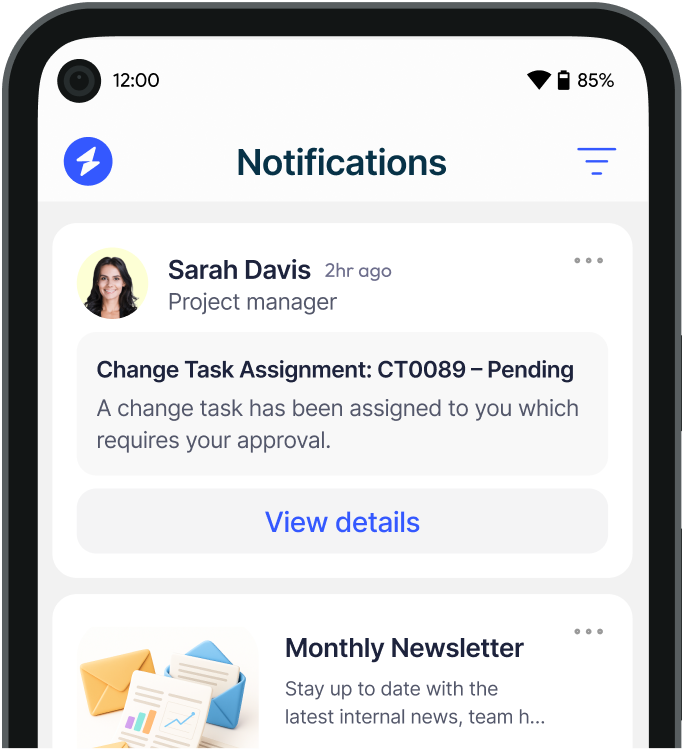
The channel choices made in the strategy directly determine whether this is achievable. Email reaches connected staff but not deskless workers; it is easy to ignore and provides no confirmation of receipt. A desktop alert pushes a message to every connected device and cannot be dismissed without acknowledgement. For a message that must reach every employee within minutes, the channel strategy matters as much as the message itself.
Acknowledgement tracking serves a second strategic purpose: it provides the organisation with a real-time view of who has and has not received the message, allowing the crisis team to follow up with non-responders and to demonstrate, if required, that every employee was informed.
A crisis communication strategy does not just govern the moment of peak pressure. It shapes how the organisation communicates at every stage of the incident — before it happens, while it is live, and after it resolves. Each phase has different objectives and different communication requirements.
The strategy is built, tested and communicated to the crisis team. Scenario planning identifies the most likely crisis types. Templates are drafted and pre-approved. Channel readiness is confirmed.
The strategy guides message sequencing: initial notification, holding statement, regular updates, all-clear. It determines which channels carry which messages and in what order. It sets the tone — factual, calm, authoritative — that all communications should maintain regardless of the severity of the incident.
The post-incident review is part of the strategy, not a postscript to it. What was communicated well? What was delayed? Which channels performed and which did not? The review feeds directly back into plan and template revisions, ensuring the strategy improves with each incident and each exercise.
See how Heed streamlines internal communication across desktop, mobile, and shared screens - so every message gets noticed.
We’ll walk you through creating, targeting, and tracking notifications in real time, tailored to your organisation’s goals.
Schedule a Demo
See how Heed works across your channels, sites and shifts, and get answers to the questions specific to your industry and team size.
Schedule a Demo




Talk to us about keeping your employees informed, engaged and inspired - book a call today!
Book a Call
Proudly connecting teams worldwide, enhancing communication, and boosting employee engagement for a unified workforce.
.svg)
.svg)
© Heed 2026 - All Rights Reserved


.svg)