Incident response has a well-established technical literature: runbooks, severity classifications, escalation trees. What is less often treated with the same rigour is the communication layer — how the right information reaches the right people at the right time to enable an effective response.
Poor communication during an incident does not just cause confusion. It causes active harm: staff acting on outdated information, duplicate efforts, missed escalations, decisions made without the data needed to make them correctly. In severe cases, it undermines the incident response itself.
Incident response communication is the set of processes that prevents this. It covers how information flows within the response team, how staff are notified and updated, how leadership is kept informed, and how the incident is formally closed.
The first communication obligation in any incident is notification: getting the right people aware of the situation as quickly as possible. The notification audience at this stage is typically the incident response team and, depending on severity, senior leadership. Speed matters more than completeness: a brief, accurate notification enables the response to start; a delayed, comprehensive briefing that arrives 40 minutes later does not.
A standard first notification covers: what has happened (or is suspected to have happened), when it was detected, what systems or people are affected, and who is leading the response. That is sufficient to start the response. Further detail follows as it becomes available.
Depending on the nature and severity of the incident, staff may need to be notified early in the response or only after an initial assessment. The communication to staff serves a different purpose than the communication to the response team: it is not a briefing, it is an instruction. It tells people what they need to know in order to do — or avoid doing — something specific.
Staff notification during an IT outage might tell people which systems are unavailable and what the workaround is. Staff notification during a building emergency tells people to evacuate, where to go, and who to contact. In both cases, the message should be specific and directive, not general and reassuring. Reassurance is appropriate; vagueness is not.
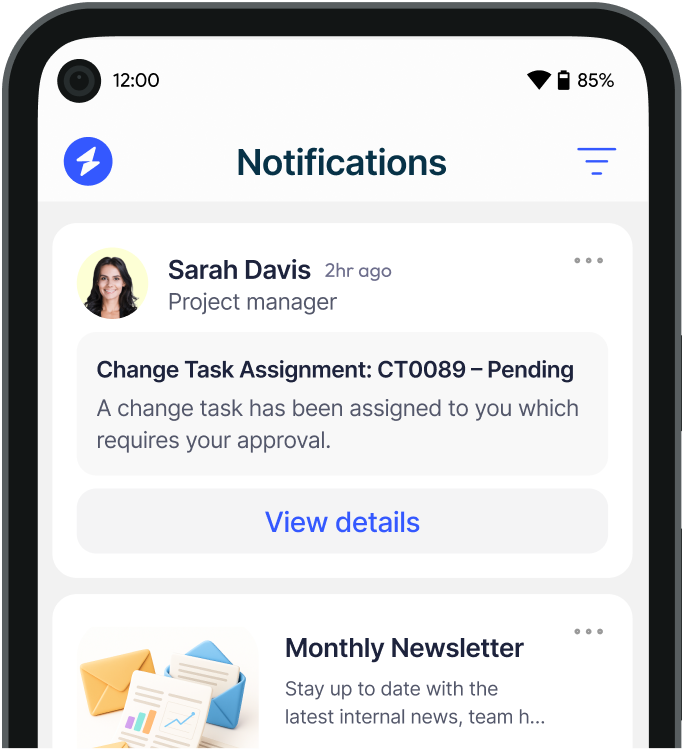
The channel for staff notification should not depend on the systems affected by the incident. An IT outage that affects email cannot be communicated through email. A desktop alert operates independently of email infrastructure and pushes a message directly to every logged-in device within seconds. For an incident requiring mandatory action, acknowledgement tracking confirms who has received and acted on the message.
During a significant incident, communication does not stop with the initial notification. Staff and leadership need to know that the response is ongoing and that the situation is understood. Regular, brief status updates — even when there is no substantive change — maintain confidence in the response and reduce the volume of inbound queries that distract the response team.
Status updates should follow a consistent format: current situation, actions underway, estimated resolution, next update time. A status update that says "the incident is under investigation" is less useful than one that says "the affected system is being restored and we expect it to be back online by 14:00. We will send a further update at 13:00." The second version gives people something to act on; the first gives them nothing.
Escalation is both a technical and a communication event. When an incident grows in severity or duration beyond initial expectations, the communication changes: the audience expands, the authority level rises, and the tone may need to shift. Leadership escalation should follow a defined path set out in the crisis communication plan, with named individuals and contact details confirmed in advance.
External escalation — notification of regulators, customers or the public — requires a different communication approach. In regulated industries, notification timelines for specific incident types may be legally defined: GDPR, for example, requires notification to the relevant supervisory authority within 72 hours of a personal data breach. These requirements should be mapped and owned before an incident, not researched during one.
Closing an incident is a communication event, not just a technical one. An all-clear message to staff should confirm that the incident has been resolved, briefly describe what happened and what was done, and indicate whether any follow-up action is required from employees. The all-clear is also the appropriate point to acknowledge the response team and, where relevant, to thank staff for their patience or cooperation.
The absence of an all-clear is a more common failure than might be expected. Staff who are not told an incident is resolved remain in a state of partial alertness that is neither comfortable nor productive. Closing the loop is a basic communication courtesy that has a measurable effect on trust.
A well-structured incident response assigns specific communication roles rather than leaving communication to whoever is available. The response lead should not also be the primary communicator: the cognitive load of managing a technical or operational response does not leave sufficient bandwidth for drafting and reviewing communications simultaneously.
A named communications lead, even for a relatively minor incident, improves the quality and speed of communications and allows the response lead to focus on the incident itself. For significant incidents, the communications lead works in parallel with the response team, producing updates on the response lead’s schedule rather than waiting for the incident to settle enough to communicate.
See how Heed streamlines internal communication across desktop, mobile, and shared screens - so every message gets noticed.
We’ll walk you through creating, targeting, and tracking notifications in real time, tailored to your organisation’s goals.
Schedule a Demo
See how Heed works across your channels, sites and shifts, and get answers to the questions specific to your industry and team size.
Schedule a Demo




Talk to us about keeping your employees informed, engaged and inspired - book a call today!
Book a Call
Proudly connecting teams worldwide, enhancing communication, and boosting employee engagement for a unified workforce.
.svg)
.svg)
© Heed 2026 - All Rights Reserved


.svg)