Article 14 requires high-risk AI systems to be designed and developed so that natural persons can oversee them effectively while they are in use. Oversight must aim to prevent or minimise risks to health, safety and fundamental rights, and the measures must be proportionate to the risks, the level of autonomy and the context of use.
The article sits in Chapter III of Regulation (EU) 2024/1689, alongside the other requirements for high-risk systems such as risk management, logging and transparency. It has five paragraphs:
The official consolidated text is published on the European Commission's AI Act Service Desk. This guide explains what the requirements mean in practice. It is not legal advice, and whether a particular system is high risk should be confirmed with qualified advisers.
Article 14 applies only to high-risk AI systems. These are systems used as safety components of products covered by EU product legislation listed in Annex I, such as machinery and medical devices, and systems used for the sensitive purposes listed in Annex III. Most everyday AI tools, such as writing assistants, are not high risk.
Annex III lists eight areas:
The employment area is the one most organisations meet first. It covers AI used to recruit or select people, including filtering applications and evaluating candidates, and AI used to make decisions about promotion, termination, task allocation or the monitoring and evaluation of staff. An employer using an AI tool for any of these purposes is likely to be a deployer of a high-risk system.
Article 6(3) allows some Annex III systems to fall outside the high-risk category where they do not pose a significant risk of harm, for example because they perform a narrow procedural task. That assessment must be documented, and it is one of the questions to settle with legal advice before deciding that Article 14 does not apply.
Following the Digital Omnibus on AI, the high-risk requirements, including Article 14, apply to Annex III systems from 2 December 2027 and to Annex I product systems from 2 August 2028. These dates replace the original deadlines of 2 August 2026 and 2 August 2027 respectively.
The changes were made by Regulation (EU) 2026/1744, adopted on 8 July 2026 and in force since 27 July 2026. The Omnibus moved the dates but, on the consolidated text published by the AI Act Service Desk, did not amend the wording of Article 14 or of the deployer duties in Article 26.
| Obligation | Applies from |
|---|---|
| Prohibited AI practices and AI literacy (Articles 4 and 5) | 2 February 2025 |
| High-risk systems listed in Annex III, including Article 14 and Article 26 | 2 December 2027 |
| High-risk systems that are safety components of Annex I products | 2 August 2028 |
| High-risk systems already on the market and intended for use by public authorities | 2 August 2030 |
The extra time is best used to design oversight properly rather than to defer it. Assigning trained people, writing procedures and testing that alerts and stop controls work all take longer than most teams expect, and the evidence that oversight works builds up only once it is running.
Paragraph 4 is the practical core of Article 14. It says the system must be provided to the deployer in a way that enables the people assigned to oversight, as appropriate and proportionate, to do five things. The table sets out each one, what it means in practice, and the evidence an organisation might keep to show it is in place.
| Article 14(4) | What overseers must be able to do | In practice | Evidence to keep |
|---|---|---|---|
| (a) | Understand the system's capacities and limitations, monitor its operation, and detect and address anomalies, dysfunctions and unexpected performance | Training on how the system works and how it fails; exception alerts that reach a named person promptly | Training records, alert and response logs, anomaly reports |
| (b) | Remain aware of automation bias, the tendency to over-rely on the system's output | Briefings on over-reliance, reviewer rotation, periodic sampling of accepted outputs | Briefing acknowledgements, sampling results, override rates |
| (c) | Correctly interpret the system's output, using the interpretation tools available | Outputs shown with the context and confidence information the provider supplies | Instructions for use, interface screenshots, reviewer guidance |
| (d) | Decide not to use the system in a particular situation, or disregard, override or reverse its output | Clear authority to override, with a simple way to record why | Override records with reasons and timestamps |
| (e) | Intervene in the system's operation or interrupt it through a stop button or similar procedure that brings it to a halt in a safe state | A tested stop procedure that named people know how to use | Stop procedure, test records, incident logs |
None of these capabilities is achieved by technology alone. Each depends on a person who has the authority to act, receives the right information in time, and responds in a way that can be shown afterwards.
Providers, who develop a high-risk system and place it on the market, must design it for effective human oversight under Article 14 and explain the oversight measures in the instructions for use. Deployers, who use the system under their authority, must assign oversight to competent people and use the system as instructed under Article 26.
| Provider (Articles 13, 14 and 16) | Deployer (Article 26) |
|---|---|
| Builds oversight measures into the system where technically feasible, including interface tools and a stop function | Takes appropriate technical and organisational measures to use the system in line with the instructions for use (Article 26(1)) |
| Identifies measures the deployer should implement and describes them in the instructions for use | Assigns human oversight to natural persons with the necessary competence, training and authority, as well as the necessary support (Article 26(2)) |
| Explains the system's capabilities, limitations and how to interpret its output | Monitors operation, informs the provider and authorities of risks or serious incidents, and suspends use where a risk is identified (Article 26(5)) |
| Designs the system to record events automatically through logging | Keeps the automatically generated logs under its control for at least six months, unless other law provides otherwise (Article 26(6)) |
| Completes conformity assessment before the system is placed on the market | Informs workers' representatives and affected workers before using a high-risk system at the workplace (Article 26(7)) |
The full deployer text is on the AI Act Service Desk page for Article 26. For most organisations, which buy rather than build AI systems, Article 26(2) is where Article 14 becomes their responsibility: the provider makes oversight possible, and the deployer makes it happen.
No. Article 14 does not require a person to approve each output of a high-risk system. It requires that people can monitor the system, interpret it, override it and stop it, with measures proportionate to the risk. The exception is remote biometric identification, where two people must verify an identification before anyone acts on it.
That leaves room for different oversight models. A person can approve each decision before it takes effect, which is usually called human in the loop, or supervise a system that acts within agreed limits and step in when something looks wrong, which is often called human on the loop. Many deployments use both, choosing per action according to its impact and reversibility. Our human in the loop AI guide explains how these models work and when each fits.
Where approval is used, it should still meet the Article 14(4) tests. An approver who receives requests in a crowded inbox, cannot see why the system made its recommendation, or approves everything by habit is not providing effective oversight, however many approvals are recorded.
Automation bias is the tendency to rely too heavily on an AI system's output, particularly when the system usually performs well. Article 14(4)(b) requires overseers to remain aware of it, especially where a high-risk system provides information or recommendations for decisions that people then take.
It is the most human of the five capabilities and the hardest to evidence. Practical measures include:
For a deployer preparing for the 2 December 2027 date, the work falls into a sequence of practical steps.
For more on how to plan where people sit in AI workflows as adoption matures, see the three stages of AI adoption and where human oversight belongs.
The Act does not prescribe an evidence format, but a deployer should be able to show who was responsible for overseeing each high-risk system, that they were trained, that they saw the requests and alerts they needed to see, and what they decided. Timestamped records tied to named individuals are the most persuasive form.
Useful records include:
A common gap is the link between the AI system and the person. The system's logs show what it produced; they rarely show that a specific person received and understood an alert in time. That is a communication problem as much as an AI one, and it is explored further in our article on why Slack and email are not a human-in-the-loop strategy for AI agents and our guide to audit-ready communication.
Under Article 99(4), breaching the obligations of providers under Article 16 or deployers under Article 26 can lead to fines of up to EUR 15 million or 3% of total worldwide annual turnover, whichever is higher. For SMEs and start-ups, each fine is capped at whichever of the two amounts is lower.
Article 14 itself is a design requirement on high-risk systems, so a provider that fails to meet it is in breach of its Article 16 obligations. A deployer that fails to assign competent oversight or to use the system as instructed is in breach of Article 26. The actual level of any fine depends on the circumstances of the case, which national authorities must take into account. The full text is on the AI Act Service Desk page for Article 99.
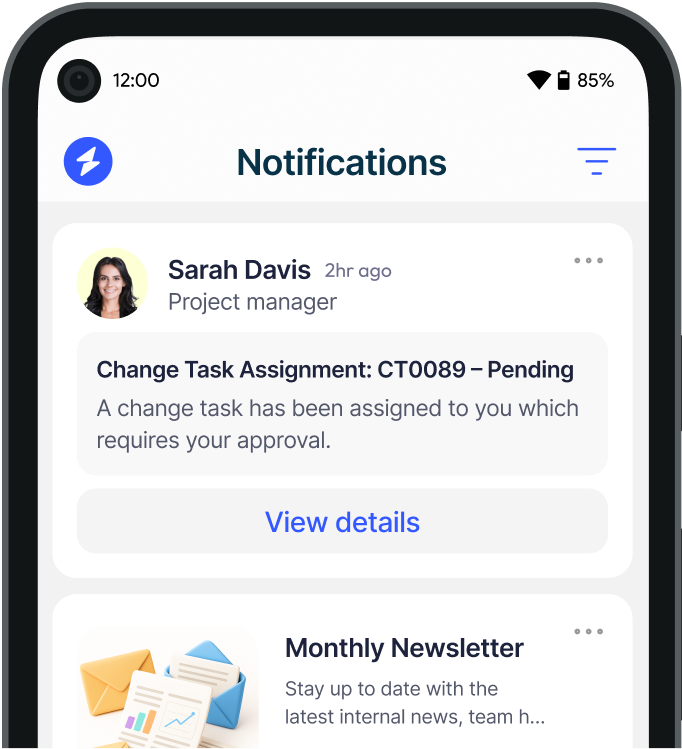
Heed is internal communication software built to make sure important messages are seen, acknowledged and recorded. Several Article 14 and Article 26 tasks depend on exactly that: getting an approval request or exception alert to a named overseer, making sure they act on it, and keeping a record that shows they did.
Heed does not decide which AI systems are high risk, does not monitor AI systems itself and does not make an organisation compliant with the EU AI Act on its own. It supports oversight by providing the dependable delivery, acknowledgement and audit trail that an oversight process relies on. Our compliance solution page covers how the same records support other regulatory obligations. Book a demo to see how oversight alerts and acknowledgements work in practice.
See how Heed streamlines internal communication across desktop, mobile, and shared screens - so every message gets noticed.
We’ll walk you through creating, targeting, and tracking notifications in real time, tailored to your organisation’s goals.
Schedule a Demo
See how Heed works across your channels, sites and shifts, and get answers to the questions specific to your industry and team size.
Schedule a Demo


Talk to us about keeping your employees informed, engaged and inspired - book a call today!
Book a Call
Proudly connecting teams worldwide, enhancing communication, and boosting employee engagement for a unified workforce.



© Heed 2026 - All Rights Reserved