An internal communication plan is a documented approach that sets out what an organisation needs to communicate to employees, why, to whom, through which channels and when. It connects business priorities to specific messages and gives communicators a shared reference for timing, ownership and measurement, rather than reacting to requests as they arrive.
An internal communications plan can cover the whole organisation for a year, a single department, or one initiative such as a system rollout or restructure. The structure is the same in each case. What changes is the scope.
Without a plan, internal communication tends to become reactive: messages compete for attention, important updates arrive through the wrong channel, and nobody can show what was read. A plan sets priorities, reduces overload and makes it possible to show that critical messages reached the right employees, which matters most in regulated industries.
There is a clear case for improvement. Gallup's State of the Global Workplace 2025 report found that global employee engagement fell to 21% in 2024. Engagement has many causes, but clear and consistent communication is one that internal communicators can influence directly.
An internal communication plan should include clear objectives linked to business goals, defined audiences, key messages, the channels for each audience, a timeline or calendar, named owners and approvers, and the measures you will use to judge success. Together these turn a list of announcements into a plan you can run and review.
What the communication needs to achieve, written as an outcome rather than an activity. "90% of staff complete the new security training by 31 March" is an objective. "Send a security email" is not.
The groups who need to hear each message, segmented by department, location, role or working pattern. Office-based, remote and frontline employees rarely need the same channel.
Three or four core points per objective, written in plain language, so every channel and spokesperson says the same thing.
Where each message will appear, chosen by urgency and audience. Routine news, mandatory updates and urgent alerts each need a different approach.
When each message goes out, including any sequence such as an announcement, a reminder and a deadline notice.
Who writes, who approves and who sends each item. Clear ownership prevents delays and conflicting messages.
How you will judge whether the plan worked: reach, read and acknowledgement rates, feedback, and the business outcome in the objective.
The steps below take you from a blank page to a plan you can run. For an organisation-wide plan, allow time for steps 1 and 2; for a single initiative, they can often be completed in a single working session.
Use the structure below as your internal communication plan template. Each row is one message or activity. Copy it into a spreadsheet or document and add rows as the plan grows.
| Objective | Audience | Key message | Channel | Timing | Owner | Measure |
|---|---|---|---|---|---|---|
| What this item must achieve | Who needs to hear it | The core point, in one sentence | Where it will appear | Date or sequence | Writer and approver | How success is judged |
| 90% of staff complete security training by 31 March | All employees | Training is mandatory and takes 20 minutes | Email, desktop alert with acknowledgement | Launch 1 March, reminders 15 and 28 March | IT security lead, approved by CISO | Acknowledgement rate, completion rate |
| Frontline staff know the new shift booking process | Site and shift workers | Book shifts in the app from 1 May | Digital signage, mobile notification, team briefing | Two weeks before go-live, then daily for one week | Operations communications | App sign-ups, support queries |
The example below shows a plan for a single initiative: moving the organisation to a new expenses system. The same structure scales to an annual plan.
Choose channels by matching each message to how urgent it is and where the audience works. Routine updates suit newsletters and the intranet; time-sensitive or mandatory messages need channels employees cannot miss, such as desktop alerts, and frontline staff need digital signage or mobile. Most plans use several channels together.
Measure an internal communication plan against the objectives it set. Track reach and read rates for each channel, acknowledgement rates for mandatory messages, and short pulse surveys on understanding. Review results quarterly, compare them with the baseline you recorded at the start, and adjust channels, timing or messages where the numbers fall short.
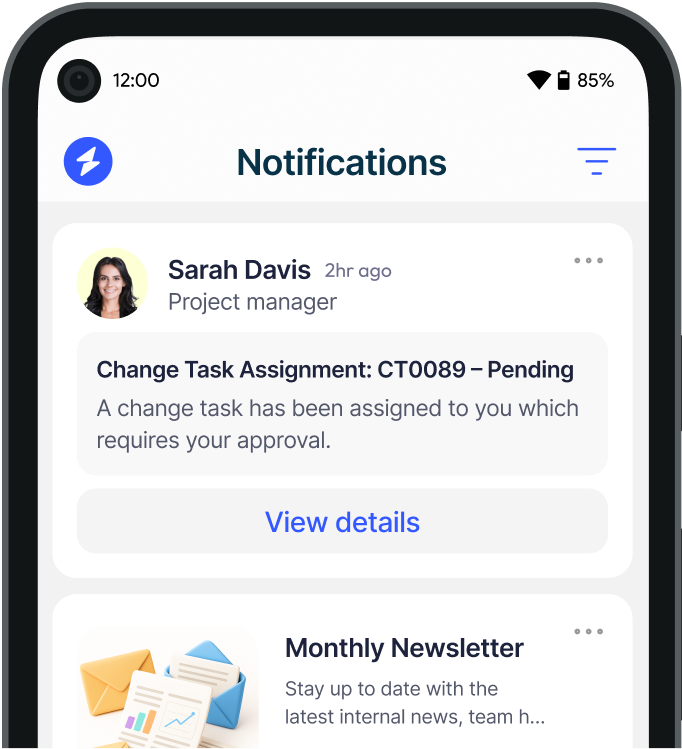
Heed is an all-in-one internal communication platform that delivers messages across desktop, mobile and digital signage from a single place. Communicators can target messages by audience, schedule them in line with the plan, require acknowledgement for mandatory items and report on who has read what, which turns the measures in your plan into data rather than estimates. Learn more about Heed for internal communications.
Heed supports on-premises deployment and regional cloud options and is ISO 27001 certified, which suits organisations in financial services, healthcare and government. Book a demo to see how Heed could support your plan.
See how Heed streamlines internal communication across desktop, mobile, and shared screens - so every message gets noticed.
We’ll walk you through creating, targeting, and tracking notifications in real time, tailored to your organisation’s goals.
Schedule a Demo
See how Heed works across your channels, sites and shifts, and get answers to the questions specific to your industry and team size.
Schedule a Demo


Talk to us about keeping your employees informed, engaged and inspired - book a call today!
Book a Call
Proudly connecting teams worldwide, enhancing communication, and boosting employee engagement for a unified workforce.


© Heed 2026 - All Rights Reserved