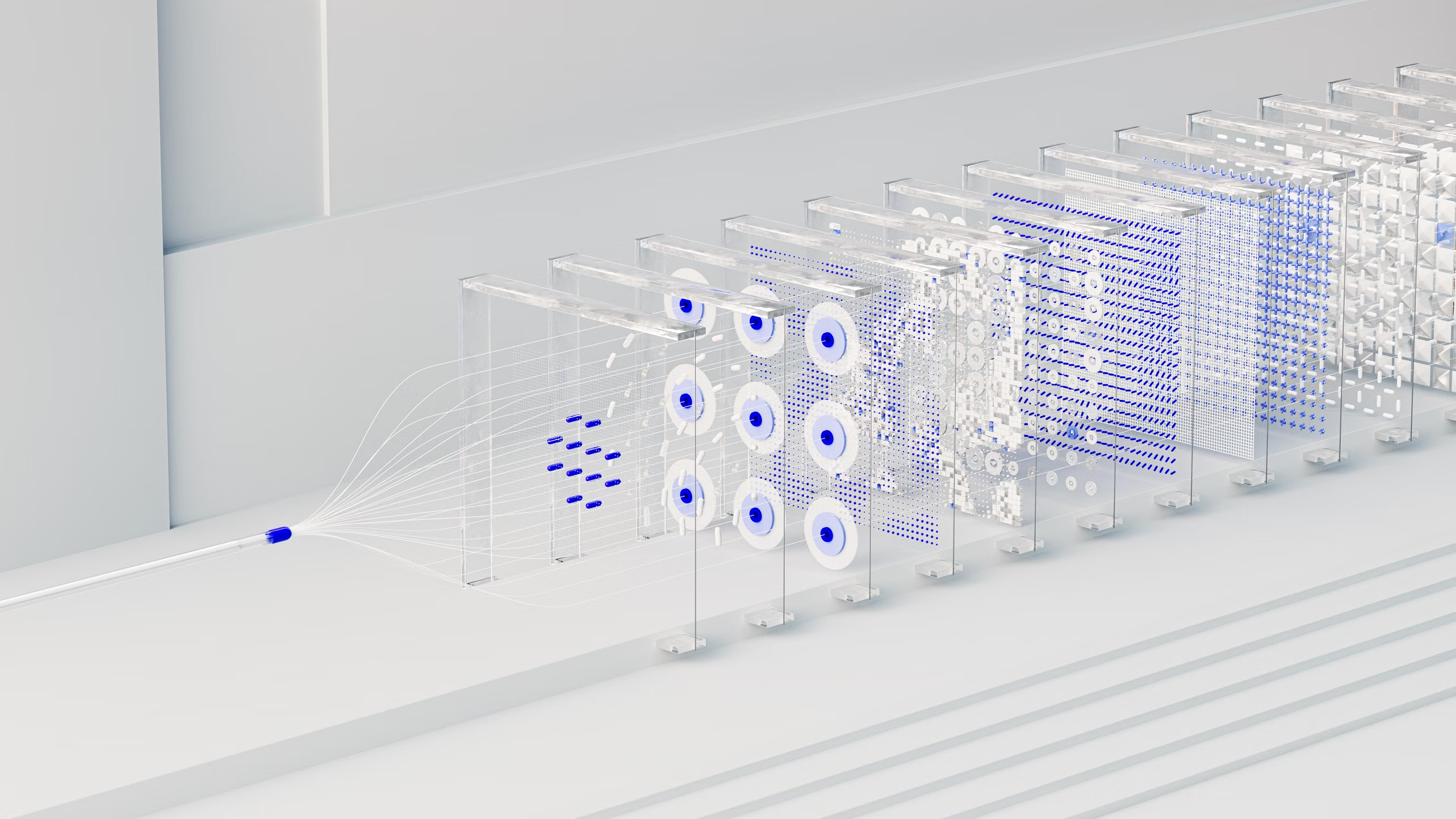
The difference is timing. In human in the loop, an AI system stops before an action and a person must approve it before anything happens. In human on the loop, the AI acts on its own while a person monitors its operation and can step in, override it or stop it when something goes wrong.
Both keep people in control of AI, but they place that control at different points. Human in the loop puts a person in the path of every decision it covers, so nothing happens without them. Human on the loop puts a person beside the process, watching outcomes and ready to intervene, so decisions flow without waiting. The diagram shows where the person sits in each model.
The human in the loop AI guide introduces these models alongside human out of the loop. This page compares human in the loop and human on the loop in depth: how each works, what each needs to be effective, how to choose between them for a given action, and how they relate to the human oversight requirements in the EU AI Act.
Human in the loop is an oversight model in which an AI system cannot complete a decision or action until a person has reviewed and approved it. The AI does the preparation, such as drafting, scoring or recommending, but a named person has the final say every time the checkpoint is reached.
Typical examples include an AI agent that drafts a supplier payment but waits for a finance approver, a model that flags a transaction for fraud but leaves the decision to block the account with an analyst, or an agent that writes a customer reply that a team member must sign off before it is sent.
The strength of the model is that errors are caught before they have an effect. The cost is speed and capacity: every decision waits for a person, and the number of decisions the process can handle is limited by how many people are available to review them.
Human on the loop is an oversight model in which an AI system makes and carries out decisions on its own, within agreed limits, while a person supervises its operation. The supervisor watches for anomalies, reviews exceptions and keeps the authority and the means to intervene, correct the system or stop it.
Typical examples include an agent that resets passwords or closes routine service tickets while an IT lead monitors volumes and errors, a system that adjusts stock orders within set limits while a planner reviews exceptions, or a model that routes customer enquiries while a team leader samples its decisions each day.
The strength of the model is throughput: decisions are made at machine speed and people focus on the cases that need them. The weakness is that a mistake has already happened by the time anyone sees it, so the model only suits actions whose effects can be detected and corrected.
The table compares the two models across the points that matter when designing oversight for AI agents and automated decisions.
| Dimension | Human in the loop | Human on the loop |
|---|---|---|
| When the person acts | Before the action, at a checkpoint | During or after the action, by exception |
| What the AI can do alone | Prepare and recommend only | Decide and act within agreed limits |
| What the person does | Approves, rejects or amends each decision | Monitors, investigates alerts, overrides or stops the system |
| Speed | Limited by how quickly approvers respond | Machine speed; people are not on the critical path |
| Volume it can handle | Limited by reviewer capacity | Limited by system capacity and the quality of monitoring |
| When errors are caught | Before they take effect | After they take effect, ideally soon after |
| Who is accountable | The named approver, for each decision | The supervisor and system owner, for the process as a whole |
| What the audit trail shows | Each request, the approver, the decision and the time | Actions taken, alerts raised, and when and how people intervened |
| Main failure mode | Rubber-stamping when approvers face too many requests | Automation bias and missed alerts when supervisors trust the system too much |
| Best suited to | Irreversible, high-value, external or rights-affecting actions | Frequent, reversible, lower-risk actions with clear limits |
Neither model is stronger in every respect. Human in the loop gives tighter control over individual decisions but does not scale; human on the loop scales but depends on supervisors noticing problems quickly and being able to act on them.
Human in command and human out of the loop sit at either end of the same spectrum. Human in command is the broadest level of oversight, deciding whether and how an AI system is used at all. Human out of the loop means the system runs with no real-time human role, with people setting rules beforehand and auditing afterwards.
The European Commission's High-Level Expert Group on AI named human in the loop, human on the loop and human in command as the three approaches to human oversight in its Ethics Guidelines for Trustworthy AI (2019). France's data protection authority, the CNIL, uses the same three categories in its guidance on using AI systems in production, describing them as:
In practice, human in command is a governance responsibility held by leadership and system owners, while human in the loop and human on the loop are operational choices made action by action. Human out of the loop is not one of the three oversight approaches; it describes the absence of real-time oversight and suits only tasks where errors are cheap and easy to reverse.
Choose per action, not per system. Use human in the loop where an action is irreversible, high value, visible outside the organisation or affects someone's rights. Use human on the loop where actions are frequent, reversible and low impact, and where problems can be detected quickly. Most AI agents need both models for different actions.
Five questions settle most cases:
Applied to common AI agent actions, the answers often look like this:
| Action | Typical model | Why |
|---|---|---|
| Supplier payment above an agreed threshold | Human in the loop | Irreversible once sent and financially significant |
| Customer refund below a small limit | Human on the loop | High volume, low value, can be corrected |
| Message to a regulator, journalist or all customers | Human in the loop | External, public and cannot be recalled |
| Routing and tagging service tickets | Human on the loop | Frequent and easy to correct |
| Granting administrator access to a system | Human in the loop | Changes security exposure and access to data |
| Blocking a suspicious login in real time | Human on the loop | Delay causes harm; the block can be lifted after review |
These are starting points, not rules. The right answer depends on your thresholds, your regulators and how well each agent has performed so far.
Choosing a model is only half the decision. Each one fails in a predictable way if the human step is not designed properly.
Both models also share a human risk. People who oversee a system that is usually right tend to defer to it, which the EU AI Act calls automation bias. Rotating reviewers, training them on how the system fails and tracking override rates all help keep oversight real. For more on why delivery is the weak point in many designs, see why Slack and email are not a human-in-the-loop strategy for AI agents.
The EU AI Act does not mandate either model by name. Article 14 requires high-risk AI systems to be designed so that people can oversee them effectively while in use, with measures proportionate to the risks, level of autonomy and context. That can be met by human in the loop, human on the loop or a combination.
Under Article 14 of Regulation (EU) 2024/1689, the people assigned to oversight must be enabled, as appropriate and proportionate, to:
Most of these describe human on the loop capabilities: monitoring, overriding and stopping. The Act goes further for one category. For remote biometric identification systems listed in point 1(a) of Annex III, no action or decision may be taken on the basis of an identification unless it has been separately verified and confirmed by at least two people with the necessary competence, training and authority, subject to limited exceptions. That is a human in the loop requirement in all but name.
Whether a particular system is high risk, and which measures are appropriate, depends on its use and should be confirmed with legal advice. Oversight design is one part of compliance, not the whole of it.
The choice is not permanent. Many organisations start a new AI agent with human in the loop for most actions, then move specific actions on the loop as evidence builds that the agent handles them well.
For a wider view of how oversight shifts as AI use matures, see the three stages of AI adoption.
Heed is internal communication software built to make sure important messages are seen, acknowledged and recorded. Both oversight models depend on that: human in the loop needs approval requests that reach a named person, and human on the loop needs exception alerts that a supervisor cannot miss.
Heed does not decide which actions need approval, does not monitor AI systems itself and does not make an AI system compliant on its own. It provides the dependable human communication step that an oversight design relies on. Book a demo to see how approval requests and exception alerts work in practice.
See how Heed streamlines internal communication across desktop, mobile, and shared screens - so every message gets noticed.
We’ll walk you through creating, targeting, and tracking notifications in real time, tailored to your organisation’s goals.
Schedule a Demo
See how Heed works across your channels, sites and shifts, and get answers to the questions specific to your industry and team size.
Schedule a Demo


FAQ
Common questions about human in the loop, human on the loop and human oversight of AI.


Talk to us about keeping your employees informed, engaged and inspired - book a call today!
Book a Call
Proudly connecting teams worldwide, enhancing communication, and boosting employee engagement for a unified workforce.



© Heed 2026 - All Rights Reserved