An internal communications strategy explains what communication must achieve for your organisation and how it will do it. Without one, internal comms teams spend their days reacting to requests: every department wants its message sent today, employees receive too much from too many places, and nobody can show leadership what any of it achieved. This guide explains what a strategy should include, how to build one in six steps, and gives a complete worked example you can adapt. When the strategy is agreed, our internal communication plan template turns it into a schedule of messages.
An internal communications strategy is a short document that sets out what employee communication must achieve for the business, which audiences matter most, the principles that guide every message, the channels used for each type of message, who owns decisions, and how success will be measured. It sets direction for two to three years and changes rarely.
A strategy is easy to confuse with the documents that sit below it. The strategy answers why and what. The internal communication plan answers what, when and through which channel for a given period or initiative. The employee communication programme is the operating rhythm of governance, cadence and feedback that keeps both running.
| Document | Question it answers | Time frame | Typical length |
|---|---|---|---|
| Internal communications strategy | Why we communicate, what it must achieve, the rules we follow | Two to three years, reviewed annually | Four to eight pages |
| Internal communication plan | Which messages go to whom, through which channel, and when | A year, a quarter or one initiative | A table with one row per message |
| Employee communication programme | How communication runs week to week: cadence, approvals, feedback | Ongoing | A set of processes and calendars |
A strategy gives internal communicators a basis for saying yes, no or not now. It ties messages to business priorities, reduces overload by setting rules for which channel carries which message, and defines measures agreed with leadership in advance, so the team can show what communication achieved rather than how much it sent.
The case for improvement is clear. Gallup's State of the Global Workplace 2026 report found that only 20% of employees globally were engaged in 2025. Engagement has many causes, but clear direction from leadership and consistent communication are among the few that internal communicators influence directly. A strategy is how you decide where to focus that influence.
An internal communications strategy should include the business context, a purpose statement, three to five measurable objectives, audience segments, guiding principles, a channel framework that matches message types to channels, governance and ownership, and the measures and review cycle. Each section should be short enough that a senior leader can read the whole strategy in fifteen minutes.
Most organisations can draft a strategy in four to six weeks. The time goes on steps 1 and 2: listening to employees and agreeing objectives with leadership. Writing the document itself is quick once those are done.
The communication strategy example below is illustrative. It describes a fictional organisation, Northfield Insurance, with 4,000 employees across a head office, four regional offices and two contact centres. Replace the context, objectives and figures with your own, and keep the structure.
Northfield is moving claims handling to a new platform over the next 18 months and consolidating two regional offices. Around a third of staff work in contact centres with limited time away from calls, and a quarter work hybrid. Last year's employee survey showed that 41% of staff felt they heard about changes from colleagues before managers, and the regulator expects evidence that staff have read updated conduct policies.
Internal communication at Northfield helps every employee understand where the business is going, what it means for their role, and what they need to do, and gives leaders a reliable way to listen as well as inform.
| Audience | How they work | What they need | Primary channels |
|---|---|---|---|
| Contact centre staff | On calls, fixed shifts, shared screens | Short, timely updates that do not interrupt calls | Desktop ticker, lock screen, digital signage, team huddles |
| Head office and regional staff | At a desk, hybrid | Context on change and how to get involved | Newsletter, intranet, desktop alerts for mandatory items |
| Line managers | Mixed | Early briefings and talking points | Manager briefing pack, desktop alert with acknowledgement |
| Senior leaders | Mixed | Feedback and sentiment data | Monthly insight report, pulse survey results |
| Message type | Primary channel | Back-up channel | Acknowledgement |
|---|---|---|---|
| Routine news and recognition | Fortnightly newsletter | Intranet | No |
| Change programme updates | Newsletter feature and manager briefing | Digital signage, screensaver | No |
| Mandatory policy updates | Desktop alert | Email, mobile push | Yes |
| Urgent operational messages | Desktop alert and SMS | Lock screen, digital signage | Yes |
| Ongoing reminders | Desktop ticker | Corporate screensaver | No |
Owner: Head of Internal Communications, reporting to the Chief People Officer. Strategy approved by the executive committee.
Prioritisation: requests are scored against the four objectives at a weekly planning meeting; all-staff channels are booked through a shared calendar.
Measures: reach and read rates by channel and site, acknowledgement rates for mandatory messages, quarterly pulse survey on feeling informed, annual survey scores, number of all-staff emails.
Review: results reported to the executive committee quarterly; full strategy review each year alongside business planning.
Measure the strategy by whether its objectives moved over the strategy period, not by how much was sent. Record a baseline for each objective at launch, then track a small set of indicators, such as survey scores on understanding, acknowledgement rates and channel reach by audience. Report the trend to leadership quarterly and revise the strategy at each annual review.
The most useful evidence combines delivery data with what employees say. Delivery data shows which audiences each channel actually reaches. Short pulse surveys, run through a tool such as Heed Survey, show whether the priorities in the strategy are understood. Count outputs, such as emails or articles published, only where an objective is to reduce them.
The most common mistakes are writing objectives as activities rather than outcomes, treating all employees as one audience, relying on email for everything, skipping the listening stage, and leaving the strategy in a drawer once it is approved. Each can be avoided by linking every section to a measure and reviewing it on a fixed date.
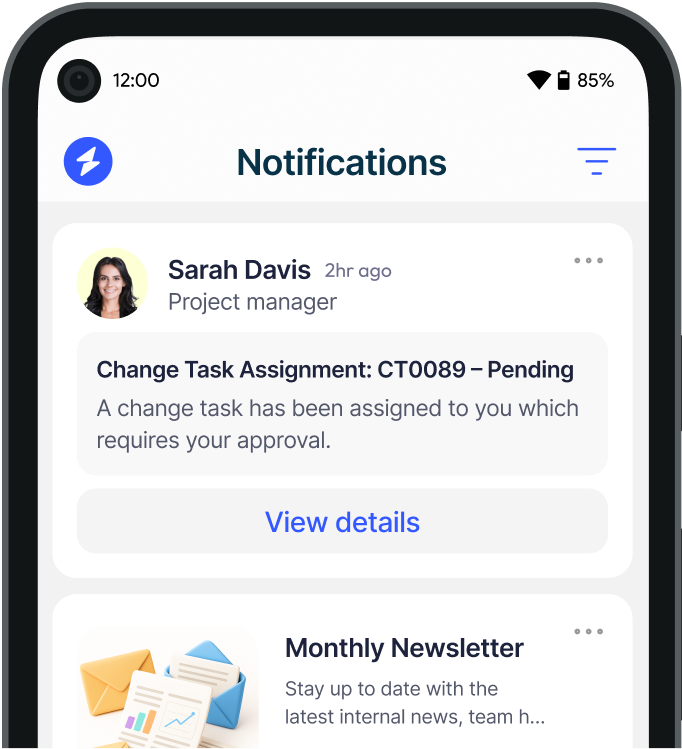
A channel framework only works if each channel can be targeted, scheduled and measured. Heed is an internal communications platform that manages desktop alerts, desktop tickers, lock screens, screensavers, digital signage, mobile push, SMS and email from one console. Communicators can target messages by department, location or role using Active Directory sync and SAML single sign-on, require named, timestamped acknowledgement for mandatory messages, and report on who has read what, so the measures in your strategy become data rather than estimates.
Heed is available as a true on-premises installation or with regional cloud hosting, and is backed by ISO 27001 certification, which suits organisations in financial services, healthcare and government. For routine news, see our employee newsletter ideas; for disruption, see the crisis communication strategy guide.
Ready to put your strategy into action? Book a demo to see how Heed delivers each type of message to the right employees and shows who has read it.
See how Heed streamlines internal communication across desktop, mobile, and shared screens - so every message gets noticed.
We’ll walk you through creating, targeting, and tracking notifications in real time, tailored to your organisation’s goals.
Schedule a Demo
See how Heed works across your channels, sites and shifts, and get answers to the questions specific to your industry and team size.
Schedule a Demo


Talk to us about keeping your employees informed, engaged and inspired - book a call today!
Book a Call
Proudly connecting teams worldwide, enhancing communication, and boosting employee engagement for a unified workforce.


© Heed 2026 - All Rights Reserved