Staff survey questions are the statements and questions an organisation asks employees to understand how they feel about their work, their managers, communication and the workplace. Most are short statements rated on an agreement scale, supported by a few open questions, so results can be compared between teams and tracked over time.
The same questions are often called employee survey questions. Whatever you call them, the aim is to gather honest feedback you can act on, rather than to collect opinions for their own sake.
Staff survey questions matter because they turn general impressions into evidence. Well-chosen questions show where engagement is falling, which teams need support and which messages are not landing. Without them, leaders tend to rely on anecdote, and problems surface only when people leave or performance drops.
The case for listening is strong. Gallup's State of the Global Workplace 2026 report found that global employee engagement fell to 20% in 2025, its lowest level since 2020. A regular staff survey will not fix engagement on its own, but it tells you where to start.
A full annual staff survey usually works best with around 25 to 40 questions, which most employees can complete in 10 to 15 minutes. A pulse survey should be much shorter, typically 5 to 15 questions. Fewer, sharper questions generally produce better response rates and more honest answers than long questionnaires.
Choose the length to suit the purpose. An annual survey gives a broad baseline across every theme. Short pulse surveys between annual surveys track a few priority measures, or check how a specific change has landed. Our article on measuring employee sentiment in real time explains how the two fit together.
Most staff surveys combine four types of question: agreement statements rated on a five-point scale, a 0 to 10 recommendation question, multiple-choice questions, and a small number of open-text questions. Rating scales make results easy to compare and track; open questions explain why people answered as they did.
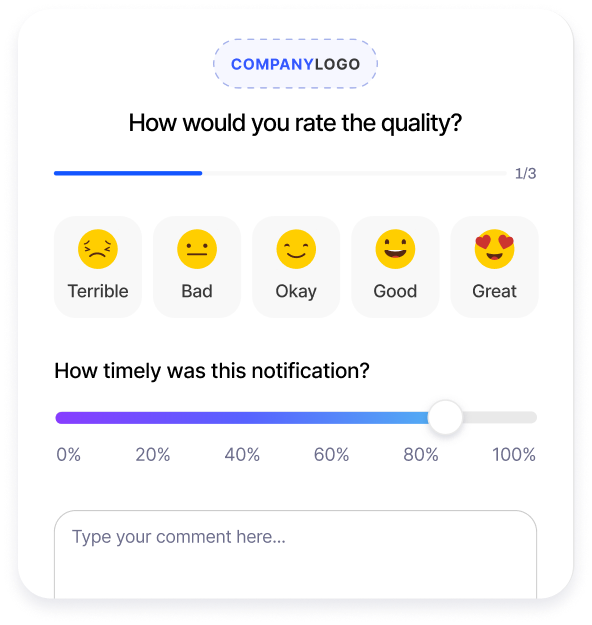
The 60 staff survey questions below are grouped into ten themes. Most are written as statements for a five-point agreement scale. Pick the themes that matter most to your organisation this year rather than using every question, and keep the wording identical from one survey to the next so you can compare results.
Engagement questions measure how committed people feel to their work and the organisation. Repeat them in every survey so you can track the trend.
These questions separate views of senior leadership from views of the line manager, because the fixes are different.
Communication questions show whether information reaches people in time to act on it, and which channels they rely on.
Wellbeing questions highlight pressure points early. Keep them neutral and avoid asking for personal health details.
Recognition questions show whether good work is noticed, which is often a stronger driver of engagement than pay alone.
Development questions are a useful early signal of retention risk, especially among newer and high-performing staff.
Culture questions test whether stated values match everyday experience for every group of employees.
These questions show how well teams work together, within and across departments.
Practical questions about tools and change often produce the quickest improvements after a survey.
Open questions explain the scores. Use two or three at most, so the survey stays quick to complete.
Use the structure below as a starting template for a 30-question annual staff survey. Copy it into your survey tool, choose three questions from each theme, and adjust the wording to suit your organisation.
| Section | What to include | Question format |
|---|---|---|
| Introduction | Purpose, how long it takes, how responses are used and who can see them | None |
| Engagement | 3 questions, including the recommendation question | Agreement scale, 0 to 10 |
| Leadership and management | 4 questions: 2 on senior leaders, 2 on line managers | Agreement scale |
| Internal communication | 3 questions | Agreement scale, multiple choice |
| Wellbeing and workload | 3 questions | Agreement scale |
| Recognition, growth and development | 5 questions | Agreement scale |
| Culture, inclusion and teamwork | 5 questions | Agreement scale |
| Tools, resources and change | 3 questions, including whether action will follow the survey | Agreement scale |
| Open questions | 2 to 3 questions | Free text |
| About you (optional) | Department, location, length of service: only in groups large enough to protect anonymity | Multiple choice |
Good staff survey questions are short, specific and neutral, and each one asks about a single thing. Write them as statements employees can rate, avoid jargon and leading wording, and only ask about topics you are prepared to act on. Test the draft with a small group before launch to catch confusing wording.
Response rates rise when employees can see the survey easily, trust that it is confidential and believe something will change. Explain the purpose before launch, keep it short, deliver it where people actually work, send reminders, and share what happened as a result of the last survey. Visible action is the strongest driver.
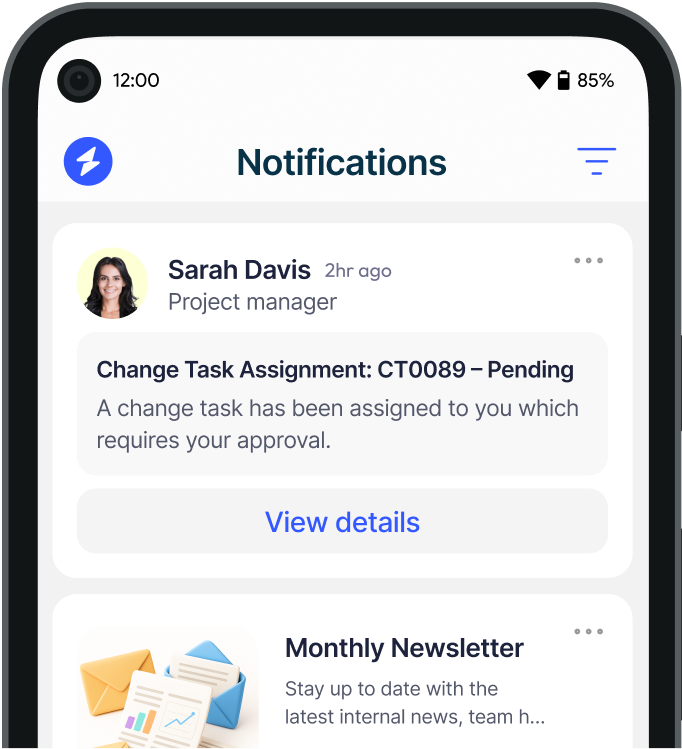
Delivery matters more than many organisations expect. A survey link buried in a busy inbox is easy to miss, particularly for frontline staff. Sending the survey as a desktop alert puts it directly on employees' screens, the Heed mobile app reaches staff who work away from a desk, and a short note in the employee newsletter can explain why it matters. Plan survey launches and results updates as part of your internal communication plan so they do not clash with other announcements.
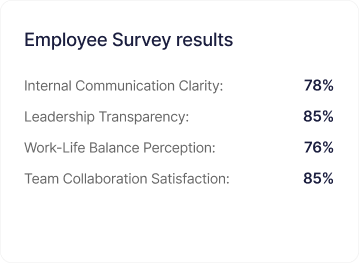
After a staff survey, share a summary of the results with employees within a few weeks, pick two or three priorities rather than trying to fix everything, and agree owners and dates for each action. Then report progress during the year and use short pulse surveys to check whether the changes are working.
For a fuller approach to acting on feedback year-round, see our guide to building a voice of the employee programme, and our article on using well-being surveys.
Heed is all-in-one internal communication software that reaches employees across desktop, mobile and digital signage. Heed Survey delivers surveys directly to employees' screens through desktop notifications, rather than relying on an email link. The survey builder supports multiple choice, ratings, text, file uploads and images, with conditional paths and branching, and surveys are responsive and multi-language, so the same survey works for a pulse check or a deep-dive.
Heed supports true on-premises deployment or regional cloud hosting with region selection for data residency, integrates with Active Directory, SSO and SAML, and is ISO 27001 certified, which suits organisations that need to keep employee feedback within their own controls. Learn more about Heed for internal communications, or book a demo to see a staff survey delivered on screen.
See how Heed streamlines internal communication across desktop, mobile, and shared screens - so every message gets noticed.
We’ll walk you through creating, targeting, and tracking notifications in real time, tailored to your organisation’s goals.
Schedule a Demo
See how Heed works across your channels, sites and shifts, and get answers to the questions specific to your industry and team size.
Schedule a Demo


Talk to us about keeping your employees informed, engaged and inspired - book a call today!
Book a Call
Proudly connecting teams worldwide, enhancing communication, and boosting employee engagement for a unified workforce.


© Heed 2026 - All Rights Reserved