
An employee engagement survey template is a ready-made questionnaire that measures how committed, motivated and connected employees feel at work. It sets out the sections, questions, rating scale and scoring method in advance, so HR and internal communications teams can launch a consistent survey quickly and compare results from one survey to the next.
A good template does more than list questions. It separates outcome questions which tell you how engaged people are, from driver questions which tell you why. That split is what turns a score into a plan. If you need a wider bank of questions on every workplace topic, start with our staff survey questions hub, then use this template when engagement is the main thing you want to measure.
Engagement is worth measuring carefully. Gallup's State of the Global Workplace 2026 report found that 20% of employees worldwide were engaged at work in 2025. A survey will not change that on its own, but it shows where your own organisation stands and which drivers to work on first.
A staff survey covers every part of working life, from tools and processes to culture and benefits. An engagement survey is narrower: it measures commitment and motivation, then asks about the handful of drivers most closely linked to them, such as managers, growth, recognition and communication. It is shorter, scored as an index and repeated more often.
Many organisations run both: a broad annual staff survey and a focused engagement survey, or engagement pulses, during the year. Keep the engagement outcome questions identical in both so that results line up.
The template below has 25 questions in six sections and takes most employees around ten minutes. Questions 1 to 5 and 7 to 22 use a five-point agreement scale from strongly disagree to strongly agree. Question 6 uses a 0 to 10 scale, and questions 23 to 25 are open text.
Suggested introduction: "This survey asks how you feel about working here. It takes about ten minutes. Responses are confidential and results are only reported for groups of [minimum group size] people or more. We will share what we learn and what we plan to do about it by [date]."
Questions 1 to 5 form your engagement index and question 6 gives your eNPS. Keep all six identical in every survey.
Line managers shape day-to-day experience more than any policy, so measure them separately from senior leadership.
These drivers often explain why engagement rises or falls among newer and high-performing employees.
Engagement depends on people understanding what is happening and why. These items test whether information reaches them in time.
Keep wellbeing items neutral and never ask for personal health information.
Two or three open questions explain the scores without making the survey long.
Add department, location and length of service only if every reporting group is large enough to protect anonymity. Use fixed multiple-choice options rather than free text.
Use this structure when you copy the template into your survey tool.
Use a five-point agreement scale for every statement: strongly disagree, disagree, neither agree nor disagree, agree and strongly agree. Add a single 0 to 10 question for employee Net Promoter Score. Keeping one scale throughout makes the survey faster to answer, removes confusion and lets you compare items and sections directly.
Avoid mixing five-point and seven-point scales, and keep the order of labels the same on every question. If you change the scale between surveys, earlier results are no longer comparable, so settle on one before the first launch.
Score each agreement item as the percentage of favourable answers, meaning agree or strongly agree. Average questions 1 to 5 to give an engagement index. Calculate eNPS from question 6 by subtracting the percentage of detractors, who score 0 to 6, from the percentage of promoters, who score 9 or 10.
To choose priorities, compare driver scores with the engagement index for each team. A driver that scores low in the teams with the lowest engagement is usually the best place to start. Read the open comments alongside the numbers, because they often explain a low score in a sentence.
Run the full 25-question survey once a year to set a baseline, and repeat a short pulse of the six engagement outcome questions plus two or three driver questions every quarter. Only survey as often as you can share results and act on them, otherwise response rates and trust tend to fall.
Our article on measuring employee sentiment in real time explains how annual surveys and pulses work together.
Share a short summary of the results with every employee. Choose two or three priorities rather than trying to fix everything and give each one an owner and a date. Ask managers to discuss their team results locally, report progress during the year and use pulse surveys to check whether the actions are working.
Employees judge a survey by what changes afterwards. If you add a question such as "I believe action will be taken as a result of this survey", expect it to fall when nothing visible happens, so make the follow-up as public as the launch. For the wider business case, see our guide to employee engagement software.
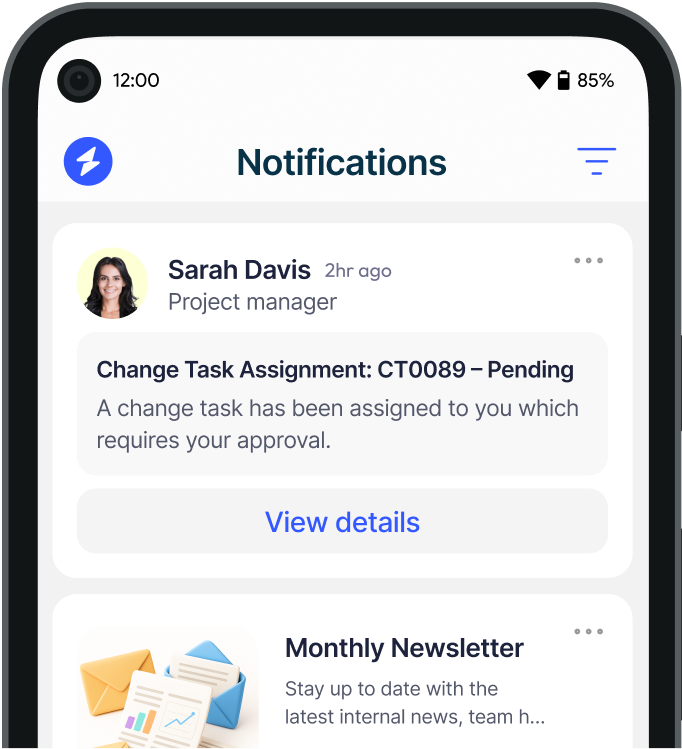
Heed is all-in-one internal communication software that reaches employees across desktop, mobile and digital signage. Heed Survey includes ready-made survey templates, including employee experience and engagement surveys. The survey builder supports agreement scales, star ratings, multiple choice, ranking, yes or no and open-text questions, with conditional paths and branching. Surveys are delivered as a desktop alert directly on employees' screens rather than as an email link and results appear in reports and dashboards as responses arrive.
Heed integrates with Active Directory, SSO and SAML 2.0, is ISO 27001 certified and can run on premises or in a regional cloud for data residency, which suits organisations that need to keep employee feedback within their own controls (see Heed security). Learn more about Heed for internal communications, or book a demo to see an engagement survey delivered on screen.
See how Heed streamlines internal communication across desktop, mobile, and shared screens - so every message gets noticed.
We’ll walk you through creating, targeting, and tracking notifications in real time, tailored to your organisation’s goals.
Schedule a Demo
See how Heed works across your channels, sites and shifts, and get answers to the questions specific to your industry and team size.
Schedule a Demo




Talk to us about keeping your employees informed, engaged and inspired - book a call today!
Book a Call
Proudly connecting teams worldwide, enhancing communication, and boosting employee engagement for a unified workforce.


© Heed 2026 - All Rights Reserved


